Cost-Benefit Analysis: Bronze vs. Bimetallic Steel-Backed Bushings
Introduction
- Introduction
- Understanding Bronze and Bimetallic Steel-Backed Bushings
- Cost Factors and Economic Considerations
- Performance Comparison Across Key Metrics
- Decision-Making Guide: Which Bushing Best Fits Your Needs
- Case Studies and Real-World Applications
- Conclusion
- FAQ
- Partner with Epen for Superior Bimetallic Bushing Solutions
- References
When evaluating bearing solutions for demanding industrial environments, the choice between solid bronze bushings and bimetallic bushing options significantly influences both immediate expenditures and long-term operational costs. Bimetallic steel-backed bushings typically deliver superior fatigue resistance and cost-effectiveness in high-load applications, while bronze bushings offer simplicity and proven reliability in moderate-duty scenarios. Understanding the technical architecture, economic implications, and performance characteristics of each material helps procurement managers, mechanical engineers, and OEM decision-makers optimize their component selection for excavators, mining equipment, marine systems, and industrial automation machinery.
Introduction
Bushings are important parts for reducing friction between moving parts in a wide range of industrial settings, from excavator boom pins to marine winch pivots. These cylindrical covers, which look simple, are very important for keeping equipment running, lowering upkeep costs, and making sure workers are safe. Choosing the right bushing material—whether it's a traditional brass alloy or a modern bimetallic steel-backed bushings design—has a direct effect on your total cost of ownership, how often you have to change them, and how well your machine works when it's under stress.
Engineers and procurement workers have to make decisions based on a complicated decision matrix that includes things like the original buy, installation needs, maintenance schedules, and what will happen if something fails. Bronze bushings have been used in machinery design for many years because they are made of simple metals and behave in reliable ways. Composite bimetallic bushings, on the other hand, solve certain tribological problems with a new two-layer design that blends the rigidity of structural steel with bearing alloys.
This study compares different options based on data about things like load capacity, wear resistance, greasing needs, and cost for mechanical engineers, R&D managers, maintenance directors, and technical sourcing teams. Our goal hasn't changed: to give you useful information that will help you make better buying decisions, cut down on downtime, and save money on heavy machinery, construction equipment, mining operations, marine applications, and industrial automation systems.
Understanding Bronze and Bimetallic Steel-Backed Bushings
Bronze Bushing Composition and Structure
Bronze bushings are made of copper-based metals that have different amounts of tin, lead, aluminium, or other elements depending on the use. Tin bronze made in the traditional way usually has 10–12% tin in it to make it strong and resistant to wear. Lead bronze versions have more lead added to them to make them easier to work with and better for emergency use. These parts are made from a single material and are made through casting, extrusion, or sintering. This makes uniform structures where the whole bushing cross-section has the same material qualities.
Because the bronze bushings are all made of the same material, they have consistent tribological behaviour and predictable wear patterns. Their ability to conduct heat helps get rid of frictional heat, and the material's natural ability to self-lubricate gives it some protection during boundary lubrication conditions. When oiled, bronze bushings usually have friction coefficients between 0.15 and 0.20, and their hardness ranges from 60 to 90 HB, based on the alloy makeup.
Bimetallic Steel-Backed Bushing Architecture
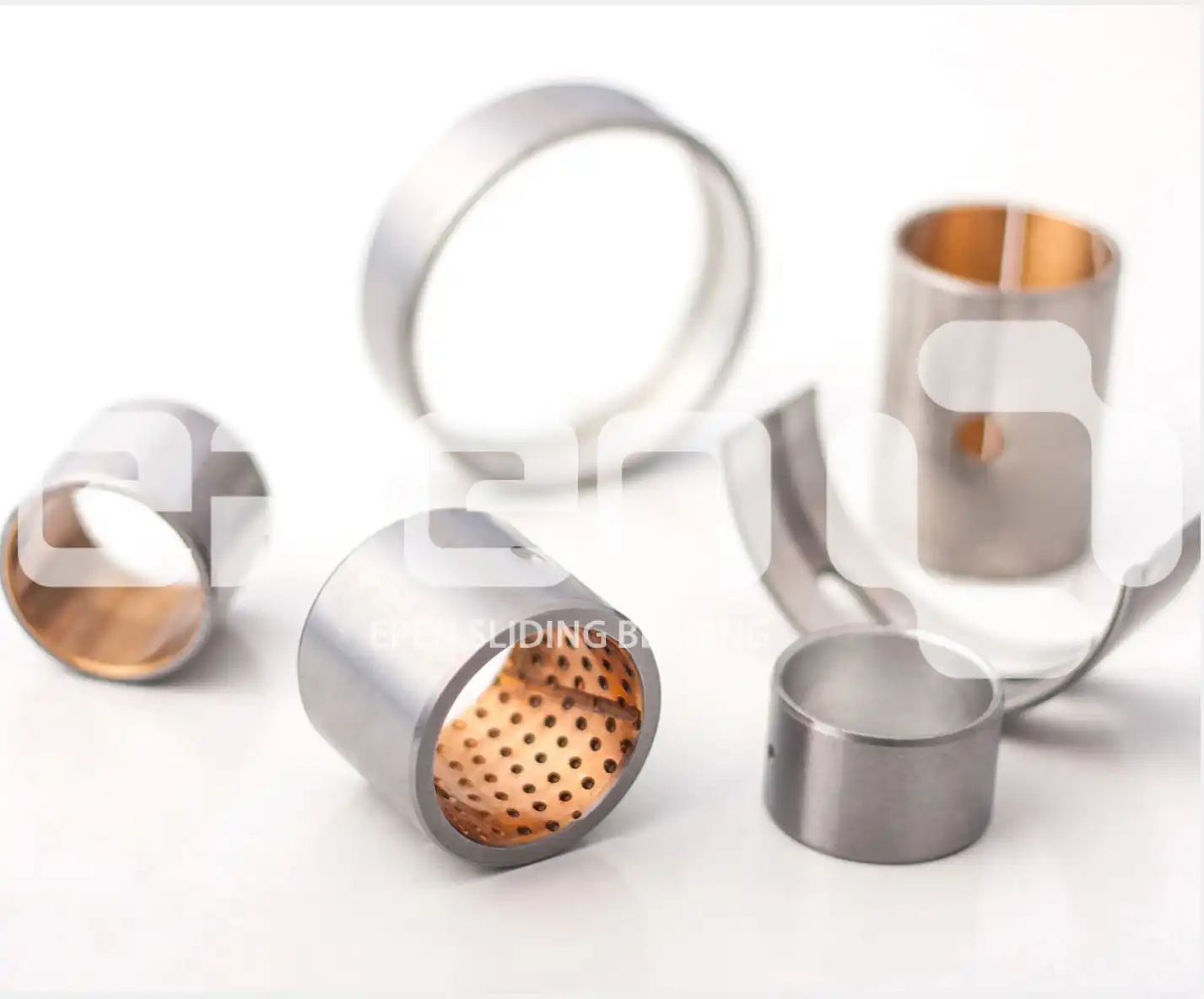
Two-part bimetallic bushings are made of a hard low-carbon steel backing (usually SAE 1010) that is attached to a precision-engineered bearing alloy lining. The steel backing usually takes up 60–70% of the total wall thickness. It gives the structure a lot of strength and stiffness. The inner lining layer, which is usually CuPb10Sn10 (with about 10% tin, 10% lead, and balanced copper) or aluminum-tin alloys, has better tribological performance.
In the manufacturing process, the bearing material is fused directly onto the steel backing under controlled temperature and pressure. This forms metallurgical links that keep the parts from coming apart when they are loaded dynamically. This layered structure solves a basic engineering trade-off: the steel backing takes care of structural needs and interference fit requirements, while the specialized inner layer improves slip resistance, embeddability, and resistance to seizures.
The maximum static load capacity for CuPb10Sn10 bimetallic bushings is 280 N/mm², and the maximum dynamic load capacity is 140 N/mm². This is a lot more than what a normal bronze bushing can handle. The composite structure has friction coefficients that range from 0.06 to 0.16, based on how well it is oiled, and it can work at temperatures up to +250°C. The lining layer has a hardness range of 70 to 100 HB, and the steel backing makes it rigid without making the bearing surface less flexible.
Fundamental Operational Differences
Different types of bushings have different structures that cause them to work differently in different industrial settings. Bronze bushings depend on the material being homogeneous, which spreads the load across the whole cross-section. These features make them likely to change size when under heavy loads, which could affect clearances and alignment over time.
Bimetallic designs separate the functions of structure and tribology into layers that work best. Even when heavy shock loads are put on building equipment pivot points and mining equipment, the steel backing doesn't bend or slide. The bearing lining's makeup can be changed to meet specific needs. For example, a high lead content can make it easier to insert in polluted areas, an aluminum-tin formulation can make it resistant to corrosion in sea settings, or lead-free options that meet environmental standards can be used.
Cost Factors and Economic Considerations
Initial Purchase Price Dynamics
The biggest difference in price between bronze and bimetallic bushings is the cost of the materials. Solid bronze bushings have higher amounts of copper and tin, which are commodities whose prices change often and are expensive. The copper content alone makes the material very expensive, especially for large-diameter bushings that are used in crane tracks or digger arms.
When you use expensive bearing metals only on the thin functional inner layer where tribological performance matters, bimetallic bushings get the most out of the materials you use. The low-carbon steel used for the steel backing is very cheap, which cuts down on the cost of raw materials while keeping the structure strong. These savings are even bigger when you buy in bulk. For example, buying the amounts that construction equipment OEMs or mine fleet maintenance programs usually do can give you big per-unit cost savings with bimetallic options.
The difficulty of making something also affects the price. The casting or milling methods needed to make bronze bushings are pretty simple. Specialized sintering tools and quality control steps are needed for bimetallic production to make sure that the layers join correctly, which could raise the cost of production. But the saves on materials usually outweigh the extra costs of production, especially for bigger bushing sizes.
Installation and Maintenance Economics
The costs of installation labor and tools depend on the type of bushing, its limits in terms of size, and how it needs to be handled. For bronze bushings to have precise bore dimensions, they may need to be machined after installation, which adds time and requires special tools. Because of how they expand and contract when heated or cooled, precise clearance calculations are needed to keep them from binding or becoming too loose across a wide range of operating temperatures.
Bimetallic bushings come with precision-ground bearing surfaces that meet ISO 3547 standards and are ready to be installed. This means that field cutting is often not needed. The physical stability of the steel backing makes pressing it into housings easier because you don't have to worry about it breaking or deforming during installation. This efficient installation cuts down on downtime during planned replacements, which is very important in mining operations where every hour of equipment availability directly translates into output.
Total Cost of Ownership Perspective
To find the item's real economic value, you have to look at more than just the purchase price. You have to consider things like installation labour, moving costs, unplanned downtime, emergency freight charges, and secondary damage risks. When bronze bushings fail in important places like offshore crane slewing rings or mine crusher links, they can cause damage to the shaft that is much more expensive to fix than just replacing the bushings.
In heavy-duty applications, bimetallic bushings offer measurable total cost advantages through longer service life, less frequent maintenance, and better ability to run in emergencies. Because they can briefly work without oil, they provide important security when lubrication systems fail, which could prevent catastrophic machine damage. The lead in CuPb10Sn10 linings makes them self-lubricating in a way that bronze bushings can't. This protects against sudden stops in lubrication that can happen on construction sites and in mines.
Teams in charge of buying things for big groups of equipment know that downtime caused by bushings costs a lot more than the prices of the parts themselves. By switching from replacing three bronze bushings a year to replacing only one bimetallic unit, two maintenance tasks are no longer needed. This saves money on labour, keeps production running smoothly, and simplifies inventory across many equipment models.
Performance Comparison Across Key Metrics
Load Capacity and Structural Strength
For heavy machinery uses, load-bearing capacity is likely the most important performance measure. Depending on the metal, bronze bushings can usually handle steady loads of 100 to 150 N/mm². When the load changes, the load capacity drops to 60 to 80 N/mm². Because of these problems, they can't be used in heavy-duty situations where shock loads regularly exceed 200 N/mm², such as in excavator stick-to-boom connections or mining equipment crusher linkages.
Bimetallic bushings with steel backing can hold up to 280 N/mm² of steady load, which is almost twice as much as bronze can do. Dynamic load handling goes up to 140 N/mm², which lets them work reliably in situations that used to need special bearing designs. This performance benefit comes directly from the structural rigidity of the steel backing, which keeps the critical clearances between the bearings and the bushings even during high-load cycles.
Wear Resistance and Service Life
How fast and how much it costs to maintain a system depend on how often and how much bushings need to be replaced. When the bearing interface is clean and well-oiled, bronze metals wear at an expected rate. However, when abrasive contaminants enter, the wear rate speeds up. This happens a lot in building, forestry, and farming equipment.
Bimetallic bushings are better at embedding because they let foreign particles sink into the relatively soft bearing lining instead of moving around in the contact zone. This feature keeps both the bushing and the mating shaft from wearing down from abrasive wear. This makes the equipment last longer in dirty places like mine crushers, harvesters, and offshore deck machinery that is exposed to sand and water.
Temperature Performance and Thermal Stability
Operating temperature ranges have a big effect on the choice of bearing material in many industrial settings. Bronze bushings work reliably from -40°C to +150°C, which covers most situations where they are heated by friction or the environment. Their ability to transfer heat helps get rid of heat caused by friction, but too high of temperatures can soften the metal and speed up wear.
Bimetallic bushings with CuPb10Sn10 linings can work continuously at +250°C, making them useful for places near engine parts, hydraulic systems or industrial furnace equipment. The steel backing stays the same size across this temperature range, and the bearing lining keeps its tribological properties. This ability to handle heat is very important in heavy-duty truck suspension systems and connecting rods for car engines, where frictional heating and outdoor engine room temperatures work together.
Decision-Making Guide: Which Bushing Best Fits Your Needs
Application-Based Recommendations
Bimetallic bushings in boom pivots, stick pins, bucket links, and base parts of heavy construction machinery like excavators, wheel loaders, and bulldozers make a big difference. The fact that these machines can handle heavy loads, are resistant to shocks, and last a long time directly addresses the rough circumstances they are used in. Bronze bushings can still be used in low-stress situations, like operator cab mounts or accessory equipment pivots, where loads are mild and there isn't much chance of contamination.
Equipment used in mining and metallurgy needs bushings that can handle constant impact loading, abrasive contamination, and tough weather conditions. Extreme duty cycles are put on bearings by crusher linkages, conveyor idlers, feeder mechanisms, and mill parts. Bimetallic bushings are perfect for these uses because they can be embedded, don't wear down easily, and are strong. Being able to keep working even when there are temporary lubrication problems is a very important way to keep equipment from breaking down in remote mine areas where repair response times can take hours.
Procurement Considerations and Supplier Selection
When buying bushings, it's important to think about more than just the material. You also need to think about the supplier's skills, quality control, customisation options, and shipping support. Mechanical engineers and procurement teams should check how technically skilled makers are in application engineering. For example, can they do load estimates, suggest the right specs, and make custom solutions for different mounting arrangements?
Following quality standards makes sure that all production runs work the same way. When suppliers follow the ISO 3547 and DIN 1494 standards, it shows that they care about the material specifications and accuracy of the dimensions that are needed for interchangeability and reliable operation. Certification paperwork, the ability to track down materials, and inspection records all help prove that parts meet technical requirements.
Case Studies and Real-World Applications
Heavy Machinery Performance Validation
A North American company that makes construction equipment recently looked at how well bushings work in the pivot points between the boom and the stick of an excavator. This is an application that experiences heavy shock loads, constant oscillation, and rough job site conditions. Their engineering team put bronze bushings to the test against CuPb10Sn10 bimetallic bushings alternatives on 50 machines that were used for demolition, mining, and moving dirt.
Performance tracking showed that bronze bushings could work for an average of 2,400 hours before they needed to be replaced because they had too much space and were showing signs of wear. Bimetallic bushings in the same places lasted an average of 5,200 hours, which is 117% longer. According to maintenance records, three cases of shaft scoring that happened with bronze bushings when dirt got into the bearing contact were fixed with bimetallic installs.
Mining Equipment Durability Outcomes
A copper mine in the western United States had to deal with frequent bushing failures in crusher connection systems that were subject to heavy impact loads and metal contamination. The original bronze bushings had to be replaced every 90 to 120 days, which caused a lot of unplanned downtime during busy production times. Maintenance teams spent a lot of time and money keeping track of inventory, planning emergency replacements, and inspecting bearings to find ones that were about to fail.
When you switch to bimetallic steel-backed bushings, the average service life goes up to 240–280 days, which means that you don't have to replace them as often. The bimetallic inner layer's ability to embeddability stopped rough ore particles from hurting mating shafts. This eliminated the need for expensive secondary repairs that came with some bushing failures in the past.
Marine Application Experience
A company that sells tools for offshore platforms did tests to see how well different rudder stock bushings worked when they were submerged in salt water all the time and had to hold heavy loads while the vessel was moving. Traditional brass bushings were good at resisting corrosion, but they wore out quickly and had to be replaced every year during drydock repair.
When exposed to high loads and rough seawater, aluminum-tin bimetallic bushings showed the same level of corrosion resistance while also reducing wear by a large amount. Long-term tests showed that these composite bushings could safely work through two drydock cycles, which cut down on the number of times they needed to be replaced and the labour costs that came with it. The dimensional stability of the steel backing kept key clearances better than bronze options.
Conclusion
Based on the economic and performance analysis, it is clear that the bimetallic bushing offers big benefits in most heavy-duty industrial settings, even though they may cost more at first. Their hybrid design makes the best use of materials by using low-cost structural steel where strength is needed and special bearing metals where tribological performance is what matters. The measurable benefits include twice or three times longer service life, higher load capacity (up to 280 N/mm²), better wear resistance due to better embeddability, and reliable operation in tough conditions that beat bronze alternatives. Total cost of ownership analysis should be more important than purchase price comparisons for procurement professionals in charge of construction equipment fleets, mining operations, marine systems, and industrial machinery. This is because longer replacement intervals, less frequent maintenance, and avoiding shaft damage usually result in strong economic returns that far exceed the initial investment differential.
FAQ
1. What specific advantages do bimetallic steel-backed bushings offer over solid bronze?
Bronze bushings can only handle 100 to 150 N/mm² of steady load, but bimetallic bushings can handle up to 280 N/mm². The steel backing doesn't bend when it's loaded suddenly, and the special bearing lining makes it easier for abrasive particles to sink into the surface instead of damaging the shafts. This composite structure makes the useful life of equipment much longer in dirty places like construction, mining, and farming.
2. Can bimetallic bushings operate reliably in high-temperature applications?
CuPb10Sn10 bimetallic bushings work steadily at temperatures up to +250°C, which is much higher than what bronze can handle, which is only +150°C. The steel backing keeps its shape over this range, and the bearing lining keeps its tribological qualities. This temperature range is good for use near engine parts, hydraulic systems, and industrial heating equipment where frictional heating and room temperature come together.
3. How do I determine which bushing type matches my specific application requirements?
Check the loading conditions, the working area, the amount of contamination, and the ease of entry for repair. When there are shock loads greater than 150 N/mm², harsh abrasive conditions, or limited access for repair, bimetallic options are usually the best choice. Bronze bushings may be enough and cost-effective for moderate-duty uses in clean settings. Talking to experienced bearing makers about technical issues can help you make the best choice based on your working conditions and budget.
Partner with Epen for Superior Bimetallic Bushing Solutions
Jiashan Epen Bearing Co., Ltd. has decades of experience making high-performance bimetallic bushing assemblies and precise wear parts for use in harsh industrial environments around the world. Our engineering team works directly with OEMs, maintenance professionals, and purchasing managers to find the best bearing options for your specific load needs, operating conditions, and budgetary goals. We can make a wide range of products, from standard catalogue sizes to fully customised designs. We can also work with different mounting options, special materials, and faster delivery times that work with your project's schedule.
As a well-known company that makes bimetallic bushings, we follow strict quality assurance procedures that are in line with ISO 3547 and DIN 1494 international standards. This makes sure that the dimensions are accurate and the materials are always the same, which is important for making sure that equipment works well. Some of the products we sell are CuPb10Sn10 high-load bushings, aluminum-tin corrosion-resistant versions, and special mixes that can handle harsh conditions in mining equipment, building gear, marine systems, and industrial automation.
Contact our technical sales team at epen@cnepen.cn to discuss your specific bushing requirements, request engineering support for application analysis, or obtain detailed quotations for volume procurement. We're committed to delivering cost-effective bearing solutions that measurably reduce your total ownership costs through extended service life and enhanced reliability.
References
1. Hutchings, I.M. & Shipway, P. (2017). Tribology: Friction and Wear of Engineering Materials. Butterworth-Heinemann, Oxford.
2. American Society of Mechanical Engineers. (2019). Plain Bearings: Design and Performance Standards for Industrial Applications. ASME Press, New York.
3. Neale, M.J. (Ed.). (2020). The Tribology Handbook: Fourth Edition. Professional Engineering Publishing, London.
4. Society of Automotive Engineers. (2018). SAE Technical Paper Series: Bearing Materials and Performance Characteristics in Heavy-Duty Applications. SAE International, Warrendale.
5. Budinski, K.G. & Budinski, M.K. (2021). Engineering Materials: Properties and Selection. Pearson Education, Upper Saddle River.
6. International Organization for Standardization. (2017). ISO 3547: Plain Bearings—Wrapped Bushes—Part 1-7: Technical Specifications and Testing Methods. ISO Standards Catalogue, Geneva.

Dr. Eleanor "Ellie" Penn
Dr. Eleanor "Ellie" Penn is our Senior Tribology Specialist at Epen, where she bridges the gap between deep material science and real-world engineering challenges. With over 15 years of experience in the field of sliding bearings and self-lubricating materials, she possesses a passion for solving the most complex problems of friction, wear, and maintenance. Ellie holds a Ph.D. in Mechanical Engineering with a focus on tribology. Her mission is to empower engineers and maintenance professionals with practical knowledge and best practices that extend equipment life, reduce downtime, and drive innovation. When she's not in the lab or writing, you can find her volunteering at STEM workshops to inspire the next generation of engineers. Areas of Expertise: Sliding Bearing Design, Material Selection, Failure Analysis, Preventive Maintenance, Application Engineering.
Contact to EPEN Bearing
If you have any questions please do not hesitate to call or write us.
