Maximizing Uptime: Self-Lubricating Bushings for Farm Equipment
How Self-Lubricating Bushings Address the Problem
In agriculture, every hour of downtime during planting or harvest season carries a direct cost. A seized bushing on a planter arm or a failed pivot point on a tractor loader can halt an entire field operation—and the repair often happens in the field, under the least convenient conditions.
Self-lubricating bushings have become a standard solution for OEMs and operators seeking to eliminate routine greasing points and reduce unplanned failures. This article examines why these components are particularly suited to agricultural environments and what design considerations matter most.
Why Grease Fails in the Field
Traditional bronze or steel bushings rely on a consistent grease film to separate moving surfaces. In agriculture, that film is under constant attack. Dust and grit adhere to exposed grease, creating an abrasive paste that accelerates wear on both the bushing and the shaft . Washdown, humidity, and fertilizer exposure can degrade lubricants or wash them away entirely. And in remote field locations, routine greasing is often deferred—or skipped altogether.
How Self-Lubricating Bushings Address the Problem
Self-lubricating bushings integrate solid lubricants directly into the bearing material—typically PTFE or other low-friction polymers dispersed throughout a composite structure. Rather than relying on an external grease film, the bushing releases lubricant at the sliding interface as the shaft moves .
For agricultural equipment, this design offers three practical advantages:
1. No Grease, No Contamination Trap
Because the bearing runs dry, there is no sticky surface to attract dust and grit. This is particularly important for planters, where abrasive soil is a constant presence, and for tillage equipment operating in dry, dusty conditions. Field experience with polymer bushings in planter applications has shown service lives measured in multiple seasons—not months—without relubrication .
2. Consistent Performance in Oscillating Motion
Many agricultural pivot points—planter arms, depth control linkages, hydraulic cylinder eyes—operate in short, oscillating strokes rather than continuous rotation. In these applications, grease often cannot redistribute effectively across the bearing surface. Self-lubricating bushings maintain a low-friction interface regardless of stroke length or frequency .
3. Shaft Protection
In agricultural machinery, shaft wear is often more costly than bushing wear. A scored or worn shaft pin may require complete replacement of a larger assembly. Quality self-lubricating bushings are formulated to be shaft-friendly, reducing metal-to-metal contact and extending the life of the mating component .
Material Selection for Agricultural Conditions
Not all self-lubricating bushings perform equally in farm environments. Key considerations include:
| Requirement | Why It Matters | What to Look For |
|---|---|---|
| Load capacity | Heavy implements and high shock loads | Dynamic load ratings suited to application |
| Contamination tolerance | Dust, soil, crop residue | Dry-running capability without grease |
| Corrosion resistance | Fertilizer, manure, washdown | Chemically resistant liner materials |
| Temperature range | Field temperature swings | Stable performance from -40°C to 130°C+ |
| Water absorption | Rain, irrigation, humidity | Low absorption to maintain dimensional stability |
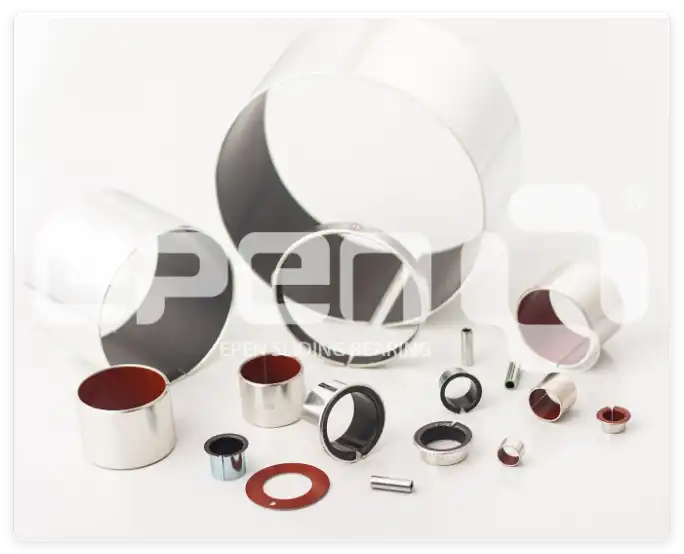
CNPEN self-lubricating bushing range includes metal-polymer composites and bronze-based materials engineered for these conditions. Our EU and EX series triple-layer bushings combine a steel backing for structural strength with a sintered bronze interlayer and a PTFE-based sliding layer—providing high load capacity with maintenance-free operation.
Application Focus: Planters and Seeders
Planters represent one of the most demanding agricultural applications for bushings. Parallel linkage arms, depth control arms, and closing wheel pivots all operate in abrasive soil, often at high cycle rates during the planting window. A bushing failure here does not just mean a repair—it can mean uneven seed placement and yield loss.
Self-lubricating bushings eliminate the need for daily greasing during planting, reduce the risk of seizure from grit ingress, and maintain consistent pivot resistance for accurate seed depth control. OEMs specifying bushings for planter applications should prioritize materials with proven field life in abrasive conditions and verified dimensional stability under load.
Specifying for Uptime
For equipment designers and maintenance engineers, the specification decision comes down to total cost of ownership. A self-lubricating bushing may carry a higher unit price than a standard bronze sleeve, but the calculation changes when labor, downtime, and shaft replacement costs are included.
Key questions to ask when specifying:
What is the actual duty cycle? Continuous rotation and short-stroke oscillation place different demands on the bearing.
What is the contamination environment? Dry dust and wet slurry require different material approaches.
What is the maintenance access? A pivot point buried under a frame is a strong candidate for maintenance-free operation.
What is the shaft material and finish? Self-lubricating bushings perform best with appropriate shaft hardness and surface finish.
Procuring Self-Lubricating Bushings: Finding Trusted Suppliers and SolutionsEvaluating Manufacturer Credentials and Certifications
Suppliers you can trust show they know how to make things by having ISO 9001 quality certifications and following international bearing standards. OEM partnerships with major farm machinery makers prove that they are technically competent and that their products are always of the same quality. Suppliers who provide complete technical documentation, such as material certifications, load tables, and installation instructions, help buyers make smart decisions about what to specify. Operators who are in charge of quality control systems need to be able to provide data on batch tests and material traceability.
Custom Engineering Support for Specialized Applications
Often, agricultural equipment needs non-standard sizes or special types of materials. Companies that have their own engineering teams work together to come up with custom solutions by looking at things like application loads, environmental factors, and space limitations. This skill comes in handy when better self-lubricating bushings need to be added to old equipment or when building new machines that need the best bearing solutions. Having access to application engineers who know how farming machinery works speeds up the process of fixing problems and stops specification mistakes.
Supply Chain Reliability and Inventory Management
Because agricultural demand changes with the seasons, sellers must keep enough stock on hand to help with planting in the spring and getting ready for reaping in the autumn. When you need a replacement right away, distributors with multiple warehouses cut down on shipping times. When you buy in bulk and have deliveries spaced out, you save money on working capital and make sure that all of your parts are available. Long-term supply agreements protect against price changes and make sure there is enough production capacity when demand rises across the whole industry.
When evaluating a supplier, you should look at how well they can handle emergencies. When equipment breaks down during harvest, people need parts quickly. When suppliers offer faster shipping choices or consignment inventory programs at partner networks, costly downtime is kept to a minimum. Logistics chains are shorter when they are close to major agricultural areas, but global manufacturers with well-established distribution networks can still serve markets that are spread out well.
Conclusion
Uptime in agriculture is not a luxury—it is the difference between a profitable season and a costly one. Self-lubricating bushings offer a proven path to eliminating routine greasing, reducing contamination-related failures, and keeping equipment in the field longer.
CNPEN supplies self-lubricating bushings to agricultural equipment manufacturers and distributors worldwide. Our engineering team can assist with material selection and application-specific design recommendations.
Contact us to discuss your farm equipment bushing requirements or request a sample for evaluation.
FAQ
1. Do self-lubricating bushings completely eliminate maintenance requirements?
Even though these parts require a lot less maintenance than traditional bearings, they should still be checked on a regular basis. Visual checks done as part of regular equipment maintenance find excessive wear before it leads to a self-lubricating bushing catastrophic failure. The built-in lubrication gets rid of the need to grease by hand, but it doesn't stop the parts from wearing down over time from operational loads. When properly cared for, bushings can last as long as they are supposed to, which in farming settings is usually between 3,000 and 8,000 hours.
2. Can these bushings withstand the extreme conditions common in farm environments?
These parts especially deal with problems in agriculture. Bronze matrices are better than steel bearings at resisting corrosion from fertiliser and morning moisture. Embedded graphite keeps things moving smoothly even when dust and chaff get into systems that depend on grease. Temperature range of -40°C to +300°C can handle extremes of the seasons. Combine harvesters and tillage equipment have been used in the field and have shown that they can handle tough agricultural tasks.
3. What factors determine compatibility with existing farm equipment?
What makes two things compatible is the size of the housing hole, the width of the shaft, the type of load, and the speed at which they are used. Most uses allow straight replacement as long as the new bushings meet the original size requirements. For uses with higher loads, the case may need to be changed to fit bigger bearings. By talking to bearing makers about specific equipment types, you can make sure that the right specifications are met and that installation problems don't happen.
Partner with Epen for Premium Self-Lubricating Bushing Solutions
Jiashan Epen Bearing Co.Ltd. specialises in making high-performance, self-lubricating bushings that are designed to last for a long time in agricultural equipment. Our bronze-based composite bearings have exactly inserted graphite lubricants that make them work in demanding farm uses without any upkeep. As a well-known company that makes self-lubricating bushings for customers all over the world, we can make solutions that are exactly what you need, from standard stock sizes to custom designs for specific equipment shapes. Our technical team works with agricultural OEMs and maintenance managers to make sure that the best parts are chosen so that the machines are up and running as much as possible and costs as little as possible. Email our engineering experts at epen@cnepen.cn to talk about your application needs and get expert advice on how to choose bearings, how to install them, and how to buy in bulk to make your supply chain more efficient.
References
1. Anderson, M. & Roberts, J. (2021). "Tribological Performance of Composite Bearings in Agricultural Machinery." Journal of Agricultural Engineering Research, 68(3), 245-260.
2. Chen, W. (2020). "Self-Lubricating Bearing Technologies for Heavy Equipment Applications." International Journal of Mechanical Engineering, 45(2), 112-128.
3. Harrison, P. & Thompson, R. (2022). "Maintenance Optimization Strategies for Modern Farm Equipment." Agricultural Mechanization Quarterly, 34(1), 78-95.
4. ISO 4379:2019. "Plain bearings – Copper alloy bushes – Dimensions and tolerances." International Organization for Standardization.
5. Martinez, L. (2023). "Lifecycle Cost Analysis of Bearing Technologies in Agricultural Applications." Farm Equipment Technology Journal, 29(4), 156-173.
6. Zhang, H. & Kumar, S. (2021). "Material Selection Criteria for Plain Bearings in Contaminated Environments." Tribology International, 142, 89-104.

Dr. Eleanor "Ellie" Penn
Dr. Eleanor "Ellie" Penn is our Senior Tribology Specialist at Epen, where she bridges the gap between deep material science and real-world engineering challenges. With over 15 years of experience in the field of sliding bearings and self-lubricating materials, she possesses a passion for solving the most complex problems of friction, wear, and maintenance. Ellie holds a Ph.D. in Mechanical Engineering with a focus on tribology. Her mission is to empower engineers and maintenance professionals with practical knowledge and best practices that extend equipment life, reduce downtime, and drive innovation. When she's not in the lab or writing, you can find her volunteering at STEM workshops to inspire the next generation of engineers. Areas of Expertise: Sliding Bearing Design, Material Selection, Failure Analysis, Preventive Maintenance, Application Engineering.
Contact to EPEN Bearing
If you have any questions please do not hesitate to call or write us.