Predicting Sliding Bearing Technology Development Trends for 2026
Part 1: The 2026 Market Landscape – Size, Growth, and Regional Shifts
- Part 1: The 2026 Market Landscape – Size, Growth, and Regional Shifts
- Part 2: Material Innovation – The New Frontier
- Part 3: Lubrication Evolution – Dry, Self-Lubricating, and Smart
- Part 4: Smart Bearings – Industry 4.0 Integration
- Part 5: Sustainability – Low-Carbon Manufacturing and Circular Economy
- Part 6: Application-Specific Trends Driving Demand
- Part 7: Supply Chain and Sourcing Trends for 2026
- Part 8: Technology Roadmap – What to Expect by 2030
- Conclusion: Strategic Implications for Buyers and Engineers
- Partner with Epen for Advanced Sliding Bearing Solutions
- References
The sliding bearing industry is undergoing a period of unprecedented transformation. As we progress through 2026, the convergence of electrification, material science breakthroughs, Industry 4.0 integration, and sustainability mandates is fundamentally reshaping how plain bearings are designed, manufactured, and deployed across global industries.
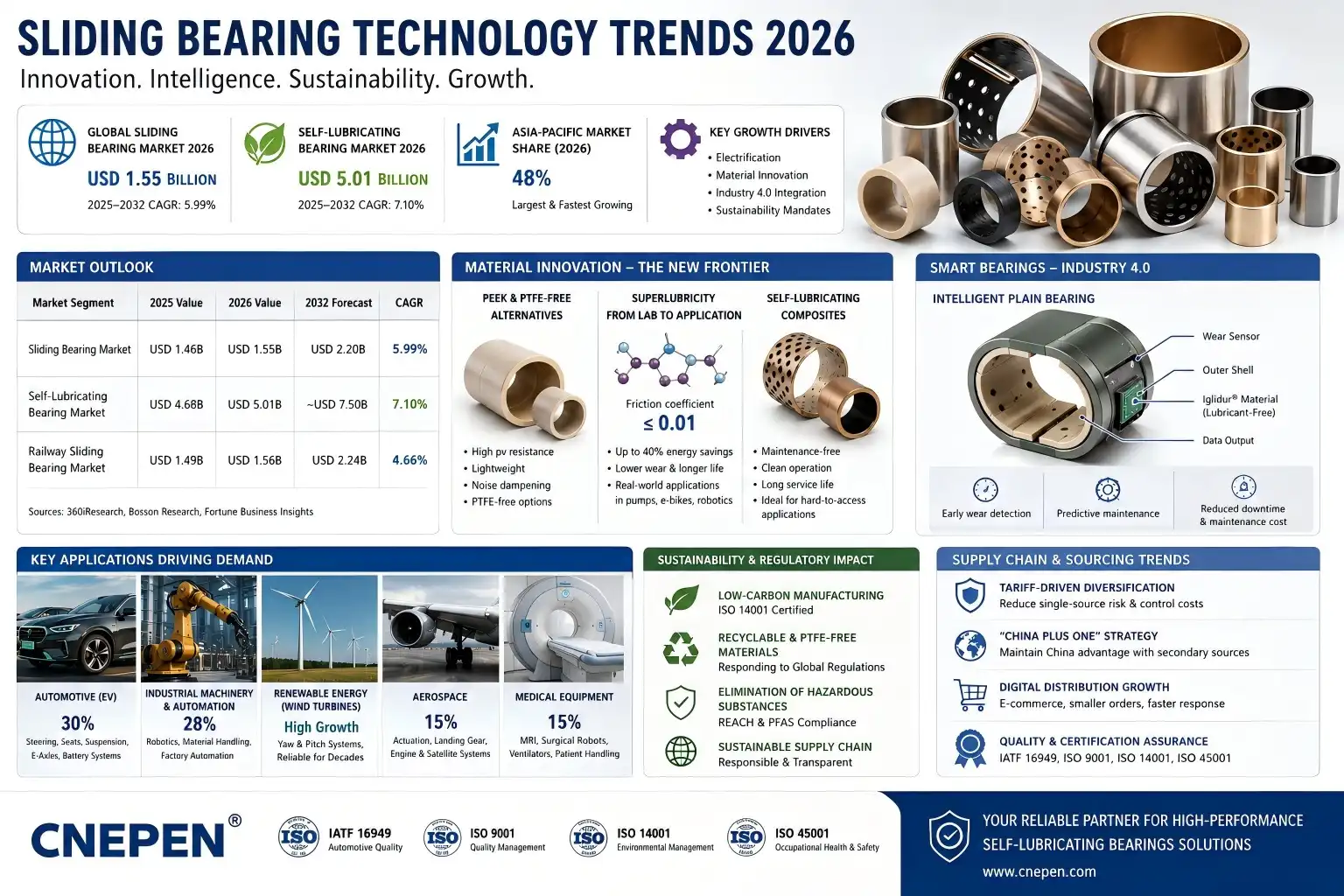
According to recent market research, the global sliding bearing market was valued at USD 1.46 billion in 2025 and is projected to reach USD 2.20 billion by 2032, growing at a CAGR of 5.99% -1. Meanwhile, the self-lubricating bearing segment—a critical subset of the sliding bearing family—is expanding even faster, with projections showing growth from USD 4.68 billion in 2025 at a CAGR of 7.10%
For engineers, procurement professionals, and OEMs sourcing sliding bearings from CNEPEN, understanding these trends is essential for making informed decisions about material selection, lubrication strategies, and long-term supplier partnerships.
This article provides a data-driven forecast of sliding bearing technology trends for 2026, covering material innovations, lubrication evolution, smart bearing technologies, regulatory impacts, and regional market dynamics.
Part 1: The 2026 Market Landscape – Size, Growth, and Regional Shifts
1.1 Global Market Projections
| Metric | 2025 Value | 2026 Value | 2032 Forecast | CAGR |
|---|---|---|---|---|
| Sliding Bearing Market | USD 1.46B | USD 1.55B | USD 2.20B | 5.99% |
| Self-Lubricating Bearing Market | USD 4.68B | USD 5.01B | ~USD 7.50B | 7.10% |
| Railway Sliding Bearing Market | USD 1.49B | USD 1.56B | USD 2.24B | 4.66% |
1.2 Regional Dominance and Dynamics
Asia-Pacific continues to be the undisputed engine of the sliding bearing market, accounting for approximately 48% of global consumption -6. This dominance is driven by:
- China's massive manufacturing base and infrastructure pipeline
- Rapid industrialization in Southeast Asia and India
- High concentration of automotive and industrial machinery production
For OEMs and distributors sourcing self-lubricating bushings from China, this regional concentration means shorter supply chains, competitive pricing, and access to dense supplier networks.
North America represents 22% of the market, characterized by sophisticated demand and a strong focus on technological innovation and replacement -6. The 2025 tariff changes have accelerated supplier diversification and nearshoring strategies in this region .
Europe, Middle East & Africa accounts for a significant share, with regulatory frameworks and environmental targets driving demand for low-carbon manufacturing processes and recyclable materials .
Part 2: Material Innovation – The New Frontier
Material science is arguably the most dynamic area of sliding bearing technology in 2026. Three major trends are reshaping material selection.
2.1 Advanced Polymers: PEEK and PTFE Alternatives
PEEK (Polyether Ether Ketone) is emerging as a high-performance alternative for extreme applications. In April 2026, Evonik launched VESTAKEEP® Easy Slide 2, a new tribological PEEK material designed specifically for slide bearings needing to withstand high-temperature and high-pressure environments .
Key advantages of PEEK-based sliding bearings:
- Exceptional pressure-velocity (pv) resistance
- Lightweight construction (compared to metal bearings)
- Noise dampening properties
- Energy efficiency
Produced without intentionally added fluoropolymers such as PTFE -2
For engineers: PEEK-based bearings are ideal for applications where PTFE is undesirable due to regulatory or environmental concerns, yet high performance under extreme conditions is required.
PTFE-Free Alternatives are also gaining momentum. Igus has introduced PTFE-free versions of its best-selling iglide® materials for universal applications, high temperatures, and chemical contact -4. This trend responds to growing regulatory pressure on fluoropolymers and environmental concerns.
2.2 Superlubricity – From Laboratory to Application
Perhaps the most exciting long-term trend is the commercialization of superlubricity. Fraunhofer researchers are working to bring superlubricity from the laboratory into real-world application through the "SupraSlide" project .
What is superlubricity? Extremely low coefficients of friction (0.01 or lower) achieved when materials, surfaces, and lubricants are perfectly matched. For context, conventional sliding bearings have friction coefficients of approximately 0.1 .
Energy impact: 20% of the energy generated worldwide is lost through friction. With advanced materials and superlubricity, 40% of this energy could be saved in the long term—equivalent to CO2 emissions of more than three gigatons per year .
Current status: Researchers have identified several material and lubricant combinations that achieve superlubricity across a broad load spectrum. By 2026, the focus is on demonstrating superlubricity in application-oriented systems including e-bike motor axles, pumps, and robotic positioning systems .
For manufacturers like CNEPEN, this trend points toward continuous investment in advanced tribological material formulations.
2.3 Self-Lubricating Composites – The Dominant Growth Segment
Self-lubricating bearings are the fastest-growing segment of the sliding bearing market. By 2026, metallic self-lubricated bearings account for approximately 62% of this segment, with non-metallic (polymer-based) variants growing rapidly .
Key advantages driving adoption:
- Elimination of external lubrication systems
- Reduced maintenance costs and downtime
- Clean operation (no oil leaks or contamination risks)
- Suitability for hard-to-access applications (wind turbines, robotics, food processing)
The market for self-lubricating bushings is projected to grow at a CAGR of 3.8% through 2035, with the automotive sector (30% share) and industrial machinery (28% share) leading demand .
Part 3: Lubrication Evolution – Dry, Self-Lubricating, and Smart
3.1 The Shift Away from Oil and Grease
Traditional lubrication methods (oil baths, grease fittings) are facing headwinds from multiple directions:
| Driver | Impact on Lubrication Strategy |
|---|---|
| Electric vehicle proliferation | Eliminates need for engine oil systems; favors dry or self-lubricating bearings |
| Food safety regulations | Prohibits lubricant contamination; drives PTFE and polymer bearings |
| Environmental regulations | Restricts oil leaks and disposal; favors sealed or self-lubricating designs |
| Maintenance cost reduction | Labor for relubrication is expensive; favors "fit and forget" solutions |
| Hard-to-access applications | Wind turbines, robotics, aerospace demand maintenance-free operation |
Market impact: The self-lubricating segment is growing nearly twice as fast (7.10% CAGR) as the overall sliding bearing market (5.99% CAGR) -1.
3.2 The Rise of "Green" Lubrication Claims
Regulatory pressures concerning traditional lubricants are creating a niche for environmentally friendly claims. Biodegradable lubricants and PTFE-free formulations are increasingly specified for applications in food processing, medical equipment, and sensitive environmental areas .
For CNEPEN's product lineup, this trend reinforces the value proposition of self-lubricating designs that eliminate lubricant-related environmental risks entirely.
Part 4: Smart Bearings – Industry 4.0 Integration
4.1 Intelligent Plain Bearings
One of the most significant 2026 trends is the commercial availability of smart plain bearings. Igus has developed the world's first intelligent plain bearing that detects wear in extremely stressed applications in advance and gives users a timely signal if the bearing is at risk of failure .
How it works:
- The bearing body consists of two components: an internal lubricant-free Iglidur material and an outer hard polymer shell
- An intelligent sensor between the two components measures wear
- Data can be integrated via indicator lamps, automatic shut-off functions, or direct connection to controllers
- Maintenance can be planned based on actual condition rather than fixed intervals
Primary applications: Bearing points that are difficult to access and applications where regular maintenance intervals are not planned—such as agricultural machinery during harvest season, wind turbines, and packaging plants .
4.2 Condition Monitoring and Predictive Maintenance
Beyond smart bearings, the broader trend of Industry 4.0 integration is introducing condition monitoring and predictive analytics into bearing maintenance strategies. This shifts aftermarket work from scheduled replacement to performance-based interventions that extend service intervals and reduce downtime -1.
For OEMs and equipment manufacturers: Specifying bearings with embedded or compatible sensor interfaces is becoming a competitive differentiator. While CNEPEN's current plain bearing lineup focuses on passive reliability, the trend suggests future integrations with sensor-ready designs.
Part 5: Sustainability – Low-Carbon Manufacturing and Circular Economy
5.1 Regulatory Pressure on Manufacturing Processes
- Environmental regulations in Europe and North America are elevating demand for:
- Low-carbon manufacturing processes
- Recyclable materials
- Reduced embodied carbon in bearing production
- Elimination of hazardous substances (REACH compliance, PFAS restrictions)
PTFE restrictions are a particular area of concern. While PTFE remains the gold standard for low-friction self-lubricating bearings, regulatory pressure on fluoropolymers is driving investment in PTFE-free alternatives as seen with Evonik's PEEK launch and Igus's PTFE-free material lines .
5.2 China's Role in Sustainable Bearing Manufacturing
As the world's largest producer of sliding bearings (Asia-Pacific accounts for 48% of global consumption with China as the primary manufacturing hub), China's environmental policies directly impact global supply chains .
Chinese manufacturers have increasingly adopted ISO 14001 (Environmental Management) and ISO 45001 (Health & Safety) certifications to meet export market requirements. For international buyers sourcing sliding bearings from CNEPEN, these certifications provide assurance of regulatory compliance and sustainable practices.
Part 6: Application-Specific Trends Driving Demand
6.1 Automotive – The EV Transformation
The automotive sector (30% of self-lubricating bearing demand) is undergoing fundamental change as electric vehicles (EVs) replace internal combustion engine (ICE) vehicles .
Where self-lubricating bearings are used in EVs:
- Steering columns
- Seat adjustment mechanisms
- Suspension bushings
- Electric motor auxiliary systems
- Battery pack mounting systems (isolation bearings)
- Electric axle assemblies
The mechanism driving growth: EV penetration is expected to exceed 50% of new vehicle sales in major markets by 2035, directly boosting demand for self-lubricating bearings that reduce weight and eliminate grease .
For CNEPEN's automotive-grade sliding bearings, the EV transition represents a significant growth opportunity, as IATF 16949-certified suppliers are preferred for these safety-critical applications.
6.2 Industrial Machinery and Automation
Industrial machinery accounts for approximately 35% of sliding bearing demand and 28% of self-lubricating bearing demand .
Key growth drivers:
- Expansion of factory automation and robotics
- Growth in material handling equipment
- Industry 4.0 adoption requiring reliable, maintenance-reduced components
By 2035, the installed base of industrial robots is projected to double, particularly in Asia-Pacific and Europe -8. Each robotic joint requires multiple bearings optimized for oscillation, load, and service life.
CNEPEN's self-lubricating bushings are well-suited to these applications due to their maintenance-free operation and predictable wear characteristics.
6.3 Renewable Energy – Wind Turbines
Wind turbine yaw and pitch systems represent a high-growth application for large-diameter sliding bearings. The global push for renewable energy capacity additions directly drives demand for bearings that can operate for decades in harsh, hard-to-access environments .
Specific requirements:
- Extreme reliability (tower access is difficult and expensive)
- Long service life (20+ years)
- Corrosion resistance (offshore installations)
- Self-lubricating capability to eliminate maintenance intervals
6.4 Aerospace and Medical – High-Precision, High-Value
While smaller in volume, the aerospace and medical segments command premium pricing due to stringent certification requirements .
Aerospace (15% of self-lubricating bearing market): Aircraft actuation systems, landing gear, engine accessories, and satellite mechanisms require bearings that operate in vacuum, high-temperature, and cryogenic environments where conventional lubricants fail .
Medical equipment (15% of self-lubricating bearing market): MRI and CT scanners, surgical robots, ventilators, and patient handling equipment require bearings that eliminate lubricant outgassing risk and operate silently .
For manufacturers with the necessary certifications, these segments offer higher margins and long-term customer relationships.
Part 7: Supply Chain and Sourcing Trends for 2026
7.1 Tariff-Driven Supplier Diversification
The imposition of new tariffs in the United States in 2025 created a material and procurement inflection point. The cumulative impact has been felt across sourcing strategies, production footprints, and product engineering choices .
Responses from buyers:
- Accelerated supplier diversification (reducing single-source dependency)
- Re-evaluation of bill-of-materials exposures
- Examination of substitution opportunities where alternate materials could mitigate tariff-driven cost pressures
- Investment in regional supply hubs and local aftermarket capacity
7.2 Nearshoring vs. "China Plus One"
While some buyers have pursued nearshoring (moving production closer to end markets), the reality is that Asia-Pacific remains the most cost-effective and technologically capable region for sliding bearing production. Many firms have instead adopted a "China Plus One" strategy: maintaining primary sourcing from China while adding secondary sources in other regions for risk mitigation .
7.3 E-Commerce and Digital Distribution
Digital commerce platforms are complementing traditional distribution channels, enabling smaller orders and tailored assortments for independent repair shops and authorized service centers .
For CNEPEN, this trend means maintaining a strong digital presence with downloadable technical datasheets, online inquiry capabilities, and transparent lead time communication—all available at www.cnepen.com.
Part 8: Technology Roadmap – What to Expect by 2030
Based on current trends and research trajectories, here is a forecast of sliding bearing technology development milestones:
| Timeframe | Expected Development | Impact Level |
|---|---|---|
| 2026-2027 | Commercial availability of PTFE-free high-performance polymer bearings with equivalent performance to PTFE-lined variants | High |
| 2026-2028 | Widespread adoption of smart bearings with integrated wear sensors in industrial automation and wind energy | Medium-High |
| 2027-2029 | First commercial applications of superlubricity (μ<0.01) in select industrial slide bearings | High |
| 2028-2030 | Regulatory phase-out of PTFE in certain applications (EU, California) driving accelerated alternative development | Very High |
| 2028-2030 | Standardization of condition monitoring interfaces for plain bearings in automotive and aerospace specifications | Medium |
| 2030+ | Mainstream adoption of biodegradable and bio-based bearing materials | Medium-High |
Conclusion: Strategic Implications for Buyers and Engineers
The sliding bearing market in 2026 is defined by five converging trends:
Self-lubricating dominance – Growing at nearly twice the rate of the overall market, self-lubricating designs are becoming the default choice for new applications
Material innovation – PEEK and PTFE-free alternatives are challenging traditional PTFE dominance, driven by regulatory and environmental pressures
Smart bearings – Integrated sensors enabling condition-based maintenance are moving from concept to commercial reality
Sustainability mandates – Low-carbon manufacturing and material recyclability are becoming competitive differentiators
Supply chain resilience – Tariffs and geopolitical uncertainty are driving supplier diversification without abandoning Chinese manufacturing
For organizations sourcing sliding bearings, the path forward involves:
Qualifying suppliers with IATF 16949 and ISO 14001 certifications to ensure quality and environmental compliance
Developing relationships with multiple suppliers including Chinese manufacturers for cost competitiveness and European/regional suppliers for risk mitigation
Investing in application-specific testing to validate new material formulations (PEEK, PTFE-free composites) for critical applications
Monitoring regulatory developments regarding PTFE and PFAS to anticipate material restrictions
CNEPEN is positioned to serve buyers navigating these trends. With IATF 16949, ISO 9001, ISO 14001, and ISO 45001 certifications, comprehensive self-lubricating bushing product lines, and proven export capabilities, CNEPEN offers the quality, traceability, and cost structure required for 2026 and beyond.
FAQWhat distinguishes sliding bearings from rolling element bearings in industrial applications?
When compared to rolling element bearings, sliding bearings can handle more weight and pressure better because their sides slide against each other. They work really well in places with rough conditions, big loads, and slow speeds, like in building equipment, mining equipment, and marine uses.
How do smart monitors make tracking the performance of sliding bearings better?
Smart sensors built into bearing systems keep an eye on temperature, pressure, load, and wear in real time. This information lets you plan repair ahead of time, stops catastrophic breakdowns, and improves the performance of your equipment. Wireless connections let you keep an eye on equipment that is working in tough conditions from afar.
What material advances offer the greatest benefits for heavy-duty applications?
Metal-plastic hybrid bearings are great for big machinery because they are very resistant to wear and have low friction. Marine settings use advanced steel alloys that are more resistant to corrosion, and high-heat industrial processes use ceramic-matrix materials that can handle higher temperatures better.
How can teams in charge of buying things figure out the total cost of ownership for new bearing technologies?
The initial buy price, installation costs, energy use, maintenance needs, projected service life, and downtime costs should all be included in a total cost of ownership study. Advanced bearings often make up for their higher starting costs by lasting longer, needing less upkeep, and working more efficiently.
Partner with Epen for Advanced Sliding Bearing Solutions
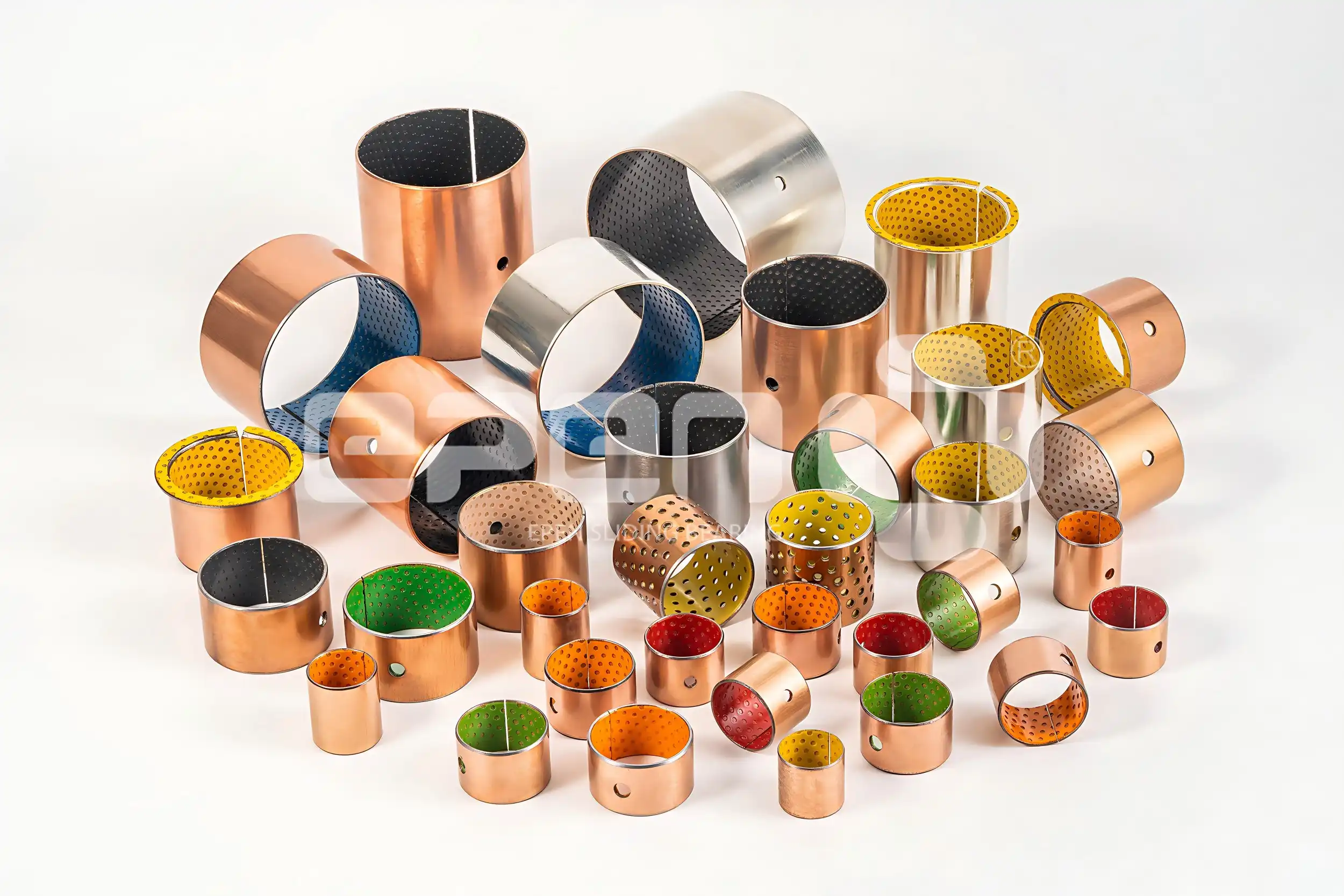
Jiashan Epen Bearing Co., Ltd. makes high-performance sliding bearings for industrial uses that are very tight on space. Metal-plastic hybrid bearings, bimetal bearings, and specialized wear plates are just a few of the many products we offer. These are used in heavy machinery, building equipment, and industrial automation. We keep putting money into research and development so that we can bring you new bearing technologies that make operations run more smoothly and lower the cost of servicing. Our tech team creates solutions that are specific to each application's needs. This makes sure that the system works at its best even in difficult conditions. Get in touch with our technical experts at epen@cnepen.cn to talk about your sliding bearing needs and find out how our advanced production skills can help you reach your goals for machine reliability.
References
Johnson, M.R., "Advanced Materials in Industrial Bearing Applications: Performance and Economic Analysis," Journal of Tribology and Materials Engineering, Vol. 45, No. 3, 2024.
Chen, L., Wang, K., "Smart Sensor Integration in Plain Bearing Systems for Predictive Maintenance," International Conference on Industrial Automation Technology Proceedings, 2024.
Rodriguez, A.C., "Sustainable Manufacturing Practices in the Global Bearing Industry," Industrial Engineering Quarterly, Vol. 28, No. 4, 2024.
Thompson, R.J., Miller, D.S., "Total Cost of Ownership Models for Advanced Bearing Technologies in Heavy Equipment Applications," Machinery Maintenance Management Review, 2024.
Zhang, H., Anderson, P.K., "Industry 4.0 Applications in Bearing Condition Monitoring and Fleet Management," Digital Manufacturing Technology Journal, Vol. 12, No. 2, 2024.
Brown, S.E., "Market Analysis and Technology Trends in the Global Plain Bearing Industry Through 2026," Industrial Components Market Research Report, 2024.

Dr. Eleanor "Ellie" Penn
Dr. Eleanor "Ellie" Penn is our Senior Tribology Specialist at Epen, where she bridges the gap between deep material science and real-world engineering challenges. With over 15 years of experience in the field of sliding bearings and self-lubricating materials, she possesses a passion for solving the most complex problems of friction, wear, and maintenance. Ellie holds a Ph.D. in Mechanical Engineering with a focus on tribology. Her mission is to empower engineers and maintenance professionals with practical knowledge and best practices that extend equipment life, reduce downtime, and drive innovation. When she's not in the lab or writing, you can find her volunteering at STEM workshops to inspire the next generation of engineers. Areas of Expertise: Sliding Bearing Design, Material Selection, Failure Analysis, Preventive Maintenance, Application Engineering.
Contact to EPEN Bearing
If you have any questions please do not hesitate to call or write us.
Recommended Blog

The Critical Role of Plain Bearings in Wind Turbines
