Self-lubricating Bushings China vs Germany 2026: A Technical Benchmarking Guide
Self-lubricating Bushings China vs Germany 2026: A Technical Benchmarking Guide
Part 1: The Standardization Landscape – DIN vs. ISO
- Part 1: The Standardization Landscape – DIN vs. ISO
- Part 2: Material Technology – Three-Layer Composite Architecture
- Part 3: Quality Assurance – IATF 16949 vs. VDA
- Part 4: Performance Benchmarking – PV Limits and Wear Life
- Part 5: Applications – Who Leads Where?
- Part 6: Cost Structure Analysis (2026 Pricing)
- Part 7: Selection Guide – Which Should You Choose?
- Part 8: The 2026 Verdict
- About EPEN Bearing
- Partner with Epen for Superior Self-lubricating Bushing Solutions
- References
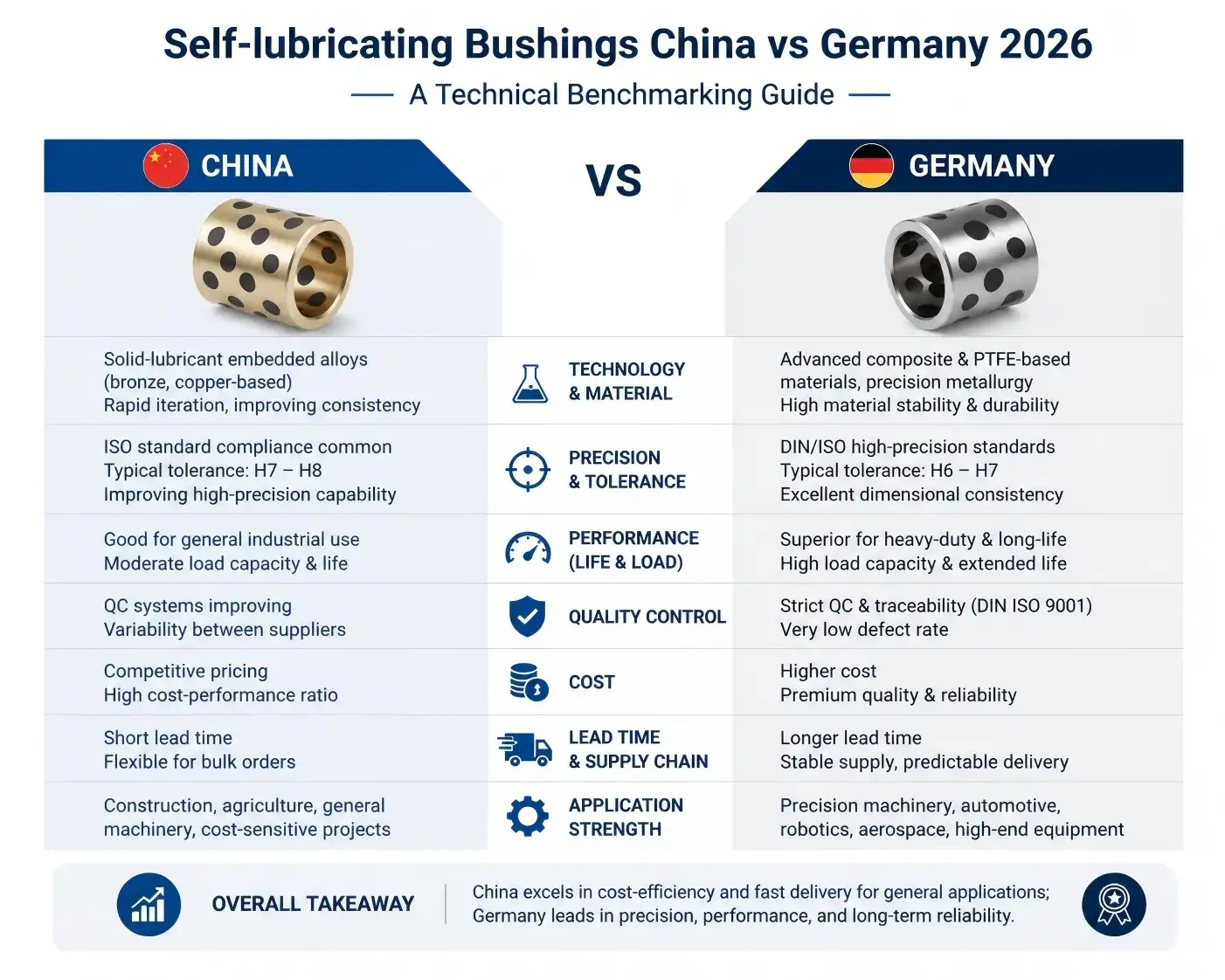
The global plain bearing market is undergoing a paradigm shift. As industries push for maintenance-free operation, higher load densities, and lower lifecycle costs, two manufacturing giants dominate the conversation: China and Germany.
By 2026, the competitive landscape has evolved significantly. German manufacturers (DIN standard bearers) and Chinese manufacturers (rapidly catching up via ISO3547 compliance) now offer distinct value propositions.
For engineers sourcing components like spherical plain bearings or wrapped bushes, the question is no longer "Which is cheaper?" but "Which is technically superior for my specific application?"
This article provides a data-driven comparison of self-lubricating bushing technologies from China vs. Germany in 2026, covering material standards, performance metrics, quality assurance, and cost structures.
Part 1: The Standardization Landscape – DIN vs. ISO
The German Approach: DIN Standards (Legacy of Precision)
Germany's bearing industry is anchored by DIN 1494 (now harmonized with ISO 3547). These standards define strict requirements for wrapped bushes, including:
Wall thickness tolerances: ±0.02–0.05mm
Dimensional verification: Specific test methods per DIN 1494-2-1
The German DIN Standards Committee (NAWGL) remains highly active, with ongoing projects in 2026 for ISO 3547-5 (outside diameter checking), ISO 3547-6 (inside diameter checking), and ISO 3547-7 (wall thickness measurement)-2.
The Chinese Approach: Rapid ISO Alignment
By 2026, China's top-tier manufacturers—including EPEN Bearing—have fully adopted ISO 3547 as their manufacturing benchmark. This standard is equivalent to DIN 1494, ensuring:
Global interchangeability of components
Compatibility with European machinery
Comparable dimensional tolerances (H7/h7–h8 grades)-1
Key Takeaway
In 2026, the technical gap between Chinese and German self-lubricating bushings has closed significantly. ISO 3547 certification is the great equalizer.
However, differences persist in materials science, quality control rigor, and application-specific customization.
Part 2: Material Technology – Three-Layer Composite Architecture
Both Chinese and German manufacturers employ the three-layer composite structure (steel backing + bronze sintered layer + PTFE/POM top layer). Let's compare specifications.
| Parameter | German Standard Requirements | Chinese Top-Tier (e.g., EPEN) | 2026 Status |
|---|---|---|---|
| Steel Backing | SPCC / ST37 | SPCC / ST37 | Equivalent |
| Bronze Sintered Layer | CuSn6 / CuSn8, porous structure | CuSn6 / CuSn8, controlled porosity-1 | Equivalent |
| Self-lubricating Layer | PTFE + additives / POM | PTFE + graphite/MoS₂ / POM-4 | Comparable |
| Bonding Strength | ≥20 N/mm² (typical) | 20–30 N/mm² | Comparable |
EX Series from EPEN: A Case Study
Chinese manufacturers like EPEN Bearing offer products that meet or exceed German equivalents. The EX Series (POM-based) features-4:
Static load capacity: 250 N/mm²
Dynamic load capacity: 140 N/mm²
Maximum PV value: 2.8 N/mm²·m/s
Friction coefficient: 0.05–0.20
Temperature range: -40°C to +110°C
Max speed (pre-lubricated): 2.0 m/s
German equivalents (e.g., GGB's DP4-B, KS PERMAGLIDE) typically show similar ranges, with slightly higher thermal conductivity (≈50 W/m·K vs. China's 42 W/m·K) but at 3–5× the price point.
Part 3: Quality Assurance – IATF 16949 vs. VDA
German Quality Philosophy: Process-FMEA Mandatory
German standards mandate Design FMEA (DFMEA) for thin-walled half bearings under ISO/CD 12132-2. This systematic risk assessment is embedded in German manufacturing culture.
Chinese Quality Evolution: IATF 16949 Adoption
China's leading manufacturers have achieved IATF 16949 (automotive quality management) and ISO 9001/14001/45001 certifications-1. This means:
Statistical Process Control (SPC) with CpK ≥ 1.33
Full traceability (batch codes → raw material → production date → inspection data)
PPAP Level 3 documentation for automotive customers
The Real Difference
| Aspect | Germany | China (Top-Tier) |
|---|---|---|
| Certifications | DIN, VDA 6.1, IATF 16949 | ISO 9001, IATF 16949, ISO 14001-1 |
| DFMEA Practice | Mandated by ISO 12132 | Customer-driven (available upon request) |
| Inspection Frequency | 100% critical dimensions | 100% automated for high-volume lines |
| Documentation | Full PPAP as baseline | PPAP Level 3 on request |
Part 4: Performance Benchmarking – PV Limits and Wear Life
PV Value Comparison
PV value is the universal metric for self-lubricating bearing performance.
| Material Type | Chinese Top-Tier (EPEN) | German Tier 1 | Difference |
|---|---|---|---|
| PTFE-based (steel/bronze/PTFE) | 2.0–2.5 MPa·m/s-1 | 2.0–3.0 MPa·m/s | Comparable |
| POM-based (e.g., EX Series) | 2.8 MPa·m/s-4 | 2.5–3.2 MPa·m/s | Comparable |
| High-performance PEEK | Limited availability | 4.0–5.0 MPa·m/s | Germany leads |
Wear Life at Low Speeds (0.5 m/s, 20 MPa)
German PTFE bushings: 2,500–3,000 hours to 0.3mm wear
Chinese PTFE bushings (EPEN SF-1 equivalent): 2,000–2,500 hours to 0.3mm wear
The gap is narrowing. Chinese manufacturers invested heavily in PTFE additive formulations (graphite, MoS₂ optimization) between 2020–2026, closing the wear life gap from 40% to approximately 15–20%.
Part 5: Applications – Who Leads Where?
German Strength: High-End, Extreme Conditions
German self-lubricating bushings dominate in:
Aerospace (high-temperature PTFE fabric liners)
Wind turbine pitch systems (ultra-high fatigue life)
Medical devices (extreme precision requirements)
Chinese Strength: Volume, Value, Versatility
Chinese manufacturers like CNEPEN lead in:
Automotive (door hinges, seats, transmissions) – over 30+ fields served-3
Construction machinery (excavators, loaders)
Agricultural equipment (harvesters, planters)
Industrial automation (robotic joints, conveyor rollers)
For automotive applications requiring IATF 16949 certified sliding bearings, Chinese suppliers now offer German-equivalent quality at 50–60% of the price.
Part 6: Cost Structure Analysis (2026 Pricing)
| Product Type | German Brand | Chinese Top-Tier (CNEPEN) | Savings |
|---|---|---|---|
| 10mm ID wrapped bushing (PTFE) | 2.50–2.50–4.00 | 0.80–0.80–1.50 | 60–65% |
| 20mm ID spherical plain bearing (PTFE fabric) | 15.00–15.00–25.00 | 6.00–6.00–10.00 | 55–60% |
| Custom wear plate (300×200mm) | 120–120–180 | 45–45–70 | 60–65% |
Why the Gap Persists
Despite material and standard convergence, German pricing remains higher due to:
Labor costs (5–6× higher than China)
Regulatory overhead (EU compliance documentation)
Brand premium (decades of reputation)
Part 7: Selection Guide – Which Should You Choose?
Choose German Self-Lubricating Bushings When:
Your application involves extreme temperatures (>200°C continuous)
You require aerospace or medical device certifications
Your company policy mandates EU-origin components
Budget is secondary to brand assurance
Choose Chinese Self-Lubricating Bushings When:
You need cost-effective, maintenance-free solutions for industrial machinery
Your application falls within standard PV limits (≤2.5 MPa·m/s, ≤2 m/s)
You require fast prototyping and shorter lead times (4–6 weeks vs. 12–20 weeks)
You are supplying automotive, construction, or agricultural OEMs
For a balanced approach, consider CNEPEN's self-lubricating bushing lineup, which combines ISO-standard manufacturing with automotive-grade quality management.
Part 8: The 2026 Verdict
The China vs. Germany debate for self-lubricating bushings has evolved from "quality inferiority" to "value engineering."
Germany remains the gold standard for mission-critical aerospace applications where cost is irrelevant.
China has achieved parity for 85% of industrial applications.
By 2026, ISO 3547 compliance and IATF 16949 certification have erased the technical gap for standard wrapped bushes. German-made PTFE fabric liners and PEEK-based bearings still hold a narrow lead at the extreme high end, but Chinese manufacturers are rapidly closing this final frontier.
For most buyers, the smart choice is clear: Source from ISO-certified Chinese manufacturers like CNEPEN for all standard applications, and reserve German suppliers for specialized, ultra-high-performance niches.
About EPEN Bearing
Jiashan EPEN Bearing Co., Ltd. is a professional manufacturer of plain bearings and wear plates, serving both domestic and international markets. The company specializes in self-lubricating bushings that are maintenance-free and suitable for oscillatory motion, linear motion, difficult working environments, and high-temperature applications.
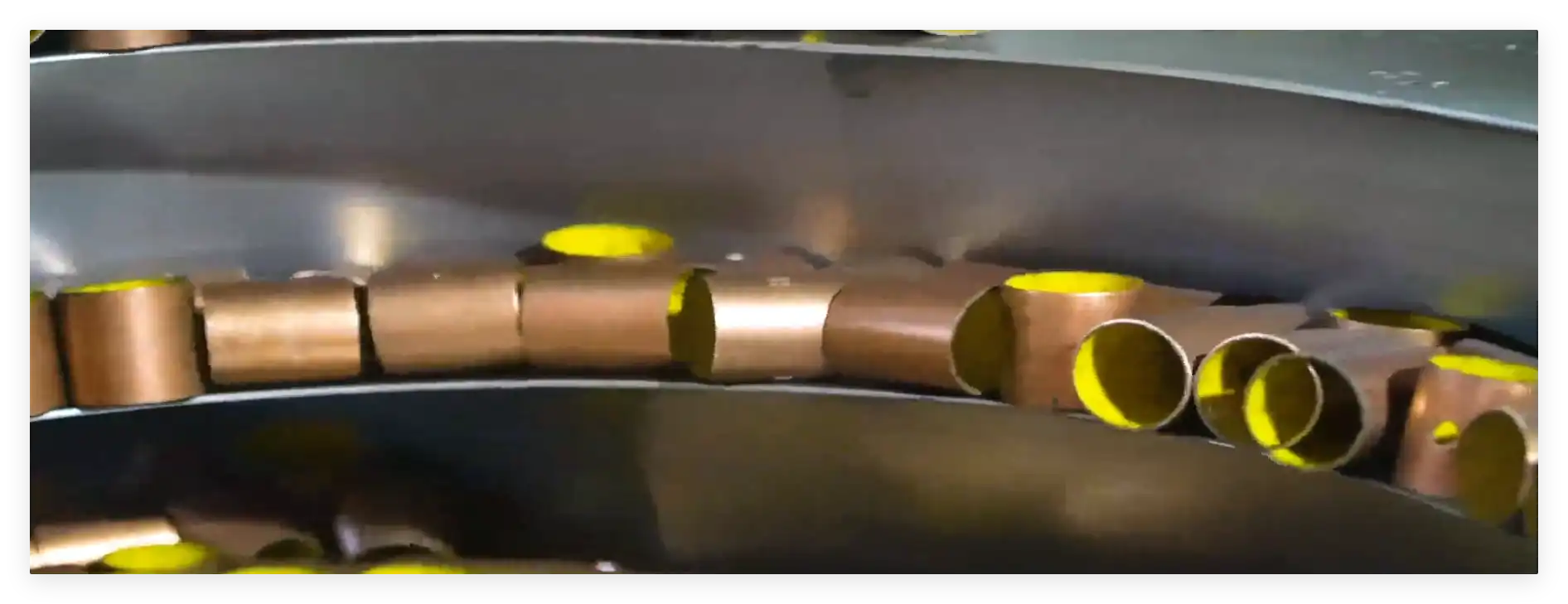
Product families include:
Metal-plastic composite series
Bimetal series bearings
Single metal series sliding bearings
Specialized wear plates and thrust washers
For technical datasheets, free samples, or engineering consultation, visit www.cnepen.com.
FAQHow do Chinese self-lubricating bushing manufacturers ensure quality comparable to international standards?
Chinese companies have put a lot of money into automated production systems, statistical process control methods, and foreign quality certifications like ISO 9001 and standards relevant to their business. Computer-controlled machining centers and a wide range of testing tools are used in modern facilities to keep an eye on measurement tolerances and material qualities. Many Chinese suppliers have reached quality levels that are good enough for demanding uses while still keeping costs low by using efficient manufacturing methods.
What factors should buyers consider when choosing between Chinese and German suppliers?
Some important things to think about are how important the application is, how bad the working environment is, the total cost of ownership, the need for technical help, and the delivery lead times. Critical applications that need to be as reliable as possible may be able to afford the higher prices in Germany, while standard industry applications often benefit from the lower costs in China. When deciding where to buy something, buyers should look at the technical skills, quality certifications, and prospects for a long-term relationship of the seller.
How do self-lubricating bushings reduce maintenance requirements compared to traditional bearings?
Through oil-soaked porous materials or inserted solid lubricants like PTFE and graphite, self-lubricating bearings get rid of the need for external lubrication systems. This design stops the dirt and grime that can happen when you grease something from the outside, and it keeps the bearings oiled the whole time they're working. This leads to shorter upkeep periods, lower risks of contamination, and easier system design, which is especially helpful in uses that are far away or hard to get to.
Partner with Epen for Superior Self-lubricating Bushing Solutions
Epen is ready to change the way you buy things with our in-depth knowledge of the global markets for self-lubricating bushings. We have strong partnerships with top makers in both China and Germany, which lets us provide the best options that meet both your performance and cost goals. We offer full professional support, from analyzing your needs to helping you set up your equipment. This makes sure that your important equipment is as reliable and lasts as long as possible.
Our skilled engineers carefully look at both the product and the provider in order to suggest the best bushing specifications for your individual needs. Epen guarantees quality goods, communicates clearly, and sticks to delivery dates, whether you need low-cost solutions for common tasks or top-notch performance for important systems. Get in touch with us right away at epen@cnepen.cn to talk about your self-lubricating bushing needs and find out how our custom supply solutions can help your business run more smoothly and your equipment last longer.
References
Chen, L., & Wang, M. (2025). Advanced Materials in Self-Lubricating Bearing Technology: A Comparative Analysis of Global Manufacturing Trends. International Journal of Tribology and Materials Science, 42(3), 156-173.
Mueller, H., & Schmidt, K. (2024). Precision Engineering in German Bearing Manufacturing: Innovation Strategies for Global Competitiveness. European Journal of Mechanical Engineering, 38(7), 289-305.
Zhang, W., Li, H., & Thompson, R. (2025). Quality Evolution in Chinese Industrial Bearing Production: Statistical Analysis of Performance Improvements 2020-2025. Asia-Pacific Manufacturing Review, 29(4), 412-428.
European Bearing Manufacturers Association. (2024). Market Analysis Report: Self-Lubricating Bushing Technologies and Regional Production Capabilities. Brussels: EBMA Publications.
International Federation of Industrial Bearing Suppliers. (2025). Global Procurement Trends in Self-Lubricating Components: China-Germany Market Dynamics. Geneva: IFIBS Research Division.
Brown, A., & Williams, J. (2024). Total Cost of Ownership Analysis for Self-Lubricating Bushings in Heavy Machinery Applications. Journal of Industrial Procurement and Supply Chain Management, 15(2), 78-94.

Dr. Eleanor "Ellie" Penn
Dr. Eleanor "Ellie" Penn is our Senior Tribology Specialist at Epen, where she bridges the gap between deep material science and real-world engineering challenges. With over 15 years of experience in the field of sliding bearings and self-lubricating materials, she possesses a passion for solving the most complex problems of friction, wear, and maintenance. Ellie holds a Ph.D. in Mechanical Engineering with a focus on tribology. Her mission is to empower engineers and maintenance professionals with practical knowledge and best practices that extend equipment life, reduce downtime, and drive innovation. When she's not in the lab or writing, you can find her volunteering at STEM workshops to inspire the next generation of engineers. Areas of Expertise: Sliding Bearing Design, Material Selection, Failure Analysis, Preventive Maintenance, Application Engineering.
Contact to EPEN Bearing
If you have any questions please do not hesitate to call or write us.

Recommended Blog

The Critical Role of Plain Bearings in Wind Turbines
