Top Factors Influencing Sliding Bearing Material Selection
Understanding Sliding Bearing Materials
- Understanding Sliding Bearing Materials
- Top Technical Factors Affecting Sliding Bearing Material Selection
- Comparing Sliding Bearing Materials with Other Bearing Types
- Procurement Considerations for Sliding Bearing Materials
- How to Choose the Right Sliding Bearing Material for Your Application
- Conclusion
- FAQ
- Partner with Epen for Superior Sliding Bearing Solutions
- References
Selecting the right sliding bearing material directly affects how much equipment costs to run, how long it lasts between repair visits, and how much it costs to maintain. When you choose bronze metals, composite plastics, or advanced metal-plastic blends, the friction coefficients, wear patterns, and thermal stability under heavy loads are all changed. When you know which material properties work best with the conditions your machinery is in—like a mining crusher that is subjected to high wear or a marine crane that is exposed to saltwater that breaks down metal—you can make buying decisions that affect both short-term project budgets and long-term asset reliability in automation, offshore, and construction settings.
Understanding Sliding Bearing Materials
The basic idea behind sliding bearing materials is simple: two surfaces move relative to each other with little friction. This is usually done by using a thin film of oil or the bearing material's own low-friction qualities. Instead of balls or rollers like rolling element bearings do, these parts rely on the properties of the material to control friction, get rid of heat, and keep them from wearing out over millions of cycles.
Common Material Categories and Their Characteristics
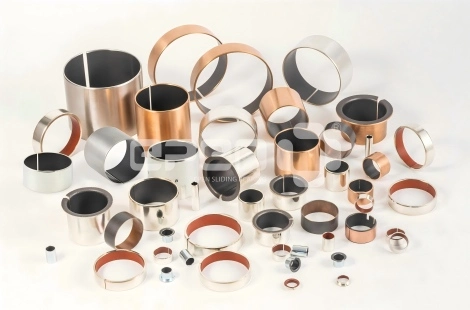
In the past, metal alloys were the only choice for heavy-duty uses. Bronze bearings, which are usually made of copper-tin metals with lead or graphite added to them, can hold a lot of weight and transfer heat well. The crushing forces in mining equipment crushers and the pivot pressures in digger booms are taken care of by these materials. Steel-backed bronze bimetals have the strength of a steel base and the workability of bronze. They hold structures well while still being able to bear weight. Stainless steel versions offer corrosion protection that is important for marine winches and remote cranes because regular materials would break down quickly in saltwater.
Plastics and materials used in engineering have become popular in places where metal bearings can't go. Materials made from polytetrafluoroethylene have very low friction coefficients and can work without any extra greasing. This makes them ideal for use in food processing equipment and sterile automation systems. Polyoxymethylene materials help keep their shape and don't wear down easily in packing and conveyor systems. Advanced composite materials combine different types of materials to achieve qualities that can't be found in a single substance. For example, a metal backing provides strength, while a porous bronze layer holds lubricants and a PTFE top lowers friction.
Metal-plastic hybrid bearings combine the strength of steel to hold weight with the wear-resistance benefits of polymer layers. In situations where metal bearings wear out too fast or where plastic materials aren't strong enough, these hybrid options come in handy. The metal base can handle compressive forces, and the plastic layer on top can handle misalignment, trap dirt, and work with little grease.
Material Properties That Define Performance
Several things about an object decide how well it works in a certain situation. The friction coefficient changes the amount of energy that is turned into heat during operation and the amount of power that needs to be applied. Wear resistance determines how long a part will last in rough conditions like those found in farming equipment that works in dusty areas or mining equipment that processes rough rock. How well the bearing gets rid of contact heat is based on its thermal conductivity. This is very important in high-speed automatic systems where heat builds up and speeds up wear. Load capacity is the most pressure a material can take before it deforms or breaks. This is directly related to the pivot points on building tools that carry the weight of the boom and arm, as well as other operational loads.
Corrosion resistance tells you which materials can handle tough chemical conditions and which ones break down quickly. For marine uses, metals must not break down in salt water, and chemical handling equipment must not be damaged by certain corrosive substances. When temperatures change during production stages, accurate machinery needs to be able to keep its limits even though the temperatures change.
Top Technical Factors Affecting Sliding Bearing Material Selection
The working environment and load profile are what cut down the sliding bearing material choices to those that will work consistently. Knowing these technical details helps match the material's abilities with what the application needs.
Load and Pressure Capabilities
The highest forces that a bearing material can handle are shown by its static and dynamic load values. Bearings are put through pressure loads that can be higher than several hundred megapascals when they are used in heavy machines like bulldozer undercarriage systems or crane slew rings. These very high pressures can't permanently change the shape of high-strength bronze metals or steel-backed composites. In lighter-duty uses, like conveyor idlers or linkages on packaging equipment, the stresses are smaller, and industrial plastics can provide enough strength while being lighter and easier to install.
Mining crushers and hammer mills, which handle materials with quick shock loads, have a lot of problems with impact loading. Materials need to be able to take these hits without breaking. Some bronze metals with controlled porosity are great at this because they can slightly bend elastically, which releases energy instead of spreading cracks.
Temperature Resistance and Thermal Management
Which materials keep their traits when exposed to heat are based on their operating temperature ranges. Standard bronze bearings work consistently up to about 200°C, after which they start to lose their effectiveness because they loosen. For uses like kiln roller bearings or hot metal handling equipment, specialized high-temperature materials make this range bigger. Most engineering plastics can only work at lower temperatures. For example, normal polyoxymethylene materials can work up to 100°C, while advanced polymers can reach 150°C before breaking down and speeding up wear.
As temperatures change, thermal expansion rates change the distance between bearings. Materials whose expansion rates are very close to those of the housing material keep the right gaps across a wide range of temperatures. This keeps the joints from sticking when they get hot or playing too much when they cool down. This is an important thing to think about, especially when it comes to precise automation equipment that needs to keep its gaps small to keep its positional accuracy.
Friction and Wear Characteristics
The friction rate between two moving surfaces tells us how much power is used, how much heat is made, and how likely it is that the surfaces will stick-slip, which makes noise and vibrations. Self-lubricating materials with solid lubricants like graphite or PTFE keep low friction coefficients without external lubrication systems. This is helpful when oil or grease could get contaminated or when repair access limits how often the parts need to be relubricated.
Wear processes change depending on the material and how it is used. Abrasive wear happens when hard particles get stuck between surfaces and grind away material. This happens a lot when farming equipment is exposed to dust from the field or when mine equipment processes rock. Surface welding between metal asperities under high contact pressures causes adhesive wear. Lead-containing bronze alloys don't wear down in this way. Marine uses where sand-filled water runs over bearing surfaces are affected by erosive wear.
Corrosion and Chemical Resistance
The environment determines the level of rust protection that is needed. Equipment on offshore platforms is constantly sprayed with saltwater, so it needs to be made of stainless steel alloys or special bronzes that don't rust. Materials that can stand up to ammonia and nitrate chemicals are needed for farm equipment that works in fertilizer settings. Certain process fluids can damage standard bearing materials, so chemical processing equipment needs to be able to work with them.
Galvanic corrosion happens when two different metals touch each other in the presence of fluids. This creates electrochemical cells that speed up the breakdown process. When choosing a material, it's important to think about how well it will work with other parts. For example, when marine settings are involved, putting bronze bearings with steel rods needs careful alloy choice to reduce galvanic potential differences.
Comparing Sliding Bearing Materials with Other Bearing Types
Knowing when sliding bearing materials work better than other options makes their uses clearer. When there is a modest load and high speed, rolling element bearings work best because they can handle faster spinning speeds than sliding surfaces can without getting too hot from friction. When boundary lubrication is used, the friction coefficients in these bearings drop to about 0.001-0.002, which is much lower than the numbers for rolling bearings, which are usually between 0.05-0.15.
Sliding bearings are useful in a number of situations. They can handle shock loads better because the whole surface area absorbs hits instead of just a few points of touch. Because they are easier, they can handle misalignment and shaft movement that would destroy a rolling element bearing. It works well in building and farming where sealed rolling bearings would need to be replaced often because they don't need much oil or are contaminated with dust.
Plain bearings are the most basic type of rolling bearing. They are just a tube of material with no other features. Modern slide bearings are better than this design because they use different layers of materials, lubricants that are built in, or surface processes that make certain qualities better. Whether you choose basic plain bearings or engineered sliding bearings relies on the amount of load, the speed, and how easy it is to do upkeep.
Different types of sliding bearings work differently depending on the materials they are made of. Bronze bearings can handle more weight and higher temps than most industrial plastics, but they need to be oiled and can't handle as much dirt. Composite materials fill in this gap by blending the power of metal with the self-lubrication and contamination tolerance of polymers. The choice matrix compares the needed load capacity with environmental factors such as dust exposure, the supply of lubrication, and the temperature ranges for operation.
Procurement Considerations for Sliding Bearing Materials
Sourcing choices for sliding bearing materials aren't just based on technical specs; they also take into account things like source trustworthiness, quality assurance, and supply chain factors that affect how long a project takes and how smoothly operations keep running.
Evaluating Manufacturers and Suppliers
The first thing that suppliers are judged on is their ability to make things and their production processes. ISO 9001 certification shows that quality management processes have been created, while certifications specific to a field show that the company has specialized knowledge. It's possible to change wait times and order sizes for big projects or current OEM production runs based on production capacity. When applications need unique solutions or when troubleshooting performance issues, technical help is important. Suppliers with application engineering tools offer more value than just providing basic materials.
Controls in the manufacturing process affect how consistent the result is. Dimensional limits that affect how well bearings fit and how much space they have between them are set by precision cutting. Metal alloys' hardness and microstructure are controlled by heat treatment methods, which have a direct effect on how well they fight wear and how much weight they can hold. Quality checking methods, such as hardness testing, dimensional verification, and material composition analysis, make sure that goods meet the requirements.
Pricing Factors and Cost Optimization
Costs of materials depend on the types of materials used, how hard they are to make, and how many orders there are. Bronze alloys with special additions are more expensive than regular tin-bronze mixtures, but they work better in tough situations and last longer, so the extra cost is worth it. Composite materials are made in several steps, including metal casting, sintering, and polymer application. These steps raise the cost of production compared to simple metal bushings, but they lower system costs by not needing to be oiled.
Volume price makes it possible for ongoing production or repair projects to cut costs. Setting up blanket orders with planned releases strikes a mix between the costs of keeping inventory and the benefits of buying in bulk. Custom tooling costs for non-standard sizes are spread out over the number of pieces ordered. Smaller runs have higher per-piece costs, while larger production amounts lower unit prices.
Lead Times and Delivery Flexibility
Standard catalog sizes can be shipped quickly from stock, but special sizes need to be made, which adds time to the wait time. Planning when to buy things around the plan of the project stops delays. For example, starting to buy bearings during the design stages of equipment instead of waiting for final assembly schedules stops critical path delays. How suppliers store their goods affects how available they are. For example, distributors who keep common sizes in stock can complete orders quickly, while makers who keep strategic material stocks cut down on lead times for custom bearings.
How to Choose the Right Sliding Bearing Material for Your Application
Systematic sliding bearing material selection compares the needs of the application to the capabilities of the material by using a structured review of performance goals and working parameters.
Assessing Operational Parameters
Load analysis measures the forces that bearings need to be able to handle. When something is fixed, the static loads are different from the dynamic loads that are found in equipment that rotates or oscillates. Peak loads during startup, shutdown, or operating transients may be higher than usual running loads and set the strength standards for the material. When you divide the load by the predicted area to get the bearing pressure, you can compare it to the material's pressure-velocity limits, which set the safe working envelopes.
The friction heating and lubrication procedures are affected by the speed ranges. In low-speed, high-load situations, boundary lubrication rules, which means that surface qualities are most important. This means that materials with solid lubricants or low shear strength surface layers work best. At faster speeds, hydrodynamic fluid bands form between the surfaces, which lets metals that are good at conducting heat get rid of frictional heat.
Matching Requirements to Material Properties
Decision models put needs in order of importance. Load capacity standards get rid of things that aren't strong enough. Materials that break down in working heat are not included in temperature limits. Materials that are easily damaged by the climate can't be used because they will rust. Comparisons are made between the surviving options based on their cost, availability, wear resistance, and friction characteristics.
Material choice is based on how related equipment has been used in the past. When making new types of construction equipment, companies use bearing materials that have been used in previous excavators or loaders. When plant engineers choose automation system bearings, they look at examples of similar equipment that has been installed successfully. Case histories from the same industry show how well materials work in similar working situations. This lowers the risk of selecting materials that haven't been tested.
Before committing to full production, testing and proof make sure that the materials are suitable. Bench testing checks wear rates in controlled settings that mimic the loads and speeds of an application. Field trials using real tools give information about how well something works in the real world, such as how it reacts to contamination, misalignment, and changes in how it's used that lab tests might miss.
Conclusion
The choice of sliding bearing materials is an important part of buying things because it affects how well things work, how much upkeep they need, and how much they cost to run. The way that load capacity, wear resistance, temperature limits, and rust resistance all affect each other makes it hard to choose the best material because none of them are perfect in every way. A good standard balances different needs. For example, bronze metals offer strength and thermal management, but they need to be oiled. Self-lubricating composites, on the other hand, require less upkeep but can't hold as much weight. When procurement teams understand these trade-offs, they can choose materials that meet practical needs, source skills, and budget limits. This is what determines the success of the project and the trustworthiness of the equipment.
FAQ
What factors most significantly affect sliding bearing lifespan?
The main thing that causes wear is the amount of load compared to the sliding bearing materials capacity. Bearings that are used near their maximum pressure levels wear out much more quickly than those that have enough safety gaps. The quality and uniformity of the lubrication decide whether the surfaces are protected by fluid layers or have boundary contact, which speeds up wear. When something is contaminated, it brings in rough bits that wear away surfaces. Extreme temperatures speed up the breakdown of chemicals and weaken materials, which shortens their useful life.
Can sliding bearing materials be recycled or refurbished?
Metal recovery methods can be used to reclaim bronze bearings and get copper and tin back to use in making new alloys. After removing the polymer layers, metal can be recycled with composite bearings that have a metal backing. Most of the time, refurbishment is not cost-effective compared to replacement because worn bearing surfaces can't be safely returned to their original sizes and qualities.
When do custom material solutions become necessary?
Standard materials may not be able to handle certain combos of high loads, temperature ranges, chemical exposures, or size restrictions. When equipment works in a lot of harsh conditions at once, like high loads with corrosive chemicals present or extreme temperatures with high speeds, it often needs custom material mixtures or stacked structures that are made for those conditions.
Partner with Epen for Superior Sliding Bearing Solutions
Jiashan Epen Bearing Co., Ltd. offers complete solutions for plain bearings and wear plates that are made to meet the tough needs of heavy machinery, industrial automation, mining, and naval uses. Metal-plastic hybrid sliding bearings, bimetal bearings, and single-metal types are just a few of the many products we offer. They are designed to meet the unique operating challenges that procurement teams in the construction equipment, metalworking, and farm machinery sectors face. As a seller of sliding bearing materials with a lot of experience, we use cutting-edge material technology and precise production skills to make both standard catalog sizes and solutions that are specially designed to fit your needs.
When it comes to choosing the right bearing materials for your application, our engineering team can help you by giving you expert advice based on things like load profiles, weather exposure, and maintenance needs. We offer materials that have been used successfully in similar situations around the world, whether you need high-load capacity bronze alloys for digger pivots, corrosion-resistant steel compositions for offshore equipment, or self-lubricating composites for automation systems. Email us at epen@cnepen.cn to talk about your needs and find out how our knowledge of sliding bearing materials can help you meet your equipment uptime and buying goals with short lead times and consistent quality.
References
Neale, M.J. (2001). The Tribology Handbook, 2nd Edition. Butterworth-Heinemann: Oxford, United Kingdom.
Khonsari, M.M. and Booser, E.R. (2008). Applied Tribology: Bearing Design and Lubrication, 2nd Edition. John Wiley & Sons: Chichester, United Kingdom.
Bhushan, B. (2013). Principles and Applications of Tribology, 2nd Edition. John Wiley & Sons: New York, United States.
ASM International Handbook Committee (1995). ASM Handbook Volume 18: Friction, Lubrication, and Wear Technology. ASM International: Materials Park, Ohio.
Stachowiak, G.W. and Batchelor, A.W. (2014). Engineering Tribology, 4th Edition. Butterworth-Heinemann: Boston, United States.
Budinski, K.G. and Budinski, M.K. (2010). Engineering Materials: Properties and Selection, 9th Edition. Pearson Education: Upper Saddle River, New Jersey.

Dr. Eleanor "Ellie" Penn
Dr. Eleanor "Ellie" Penn is our Senior Tribology Specialist at Epen, where she bridges the gap between deep material science and real-world engineering challenges. With over 15 years of experience in the field of sliding bearings and self-lubricating materials, she possesses a passion for solving the most complex problems of friction, wear, and maintenance. Ellie holds a Ph.D. in Mechanical Engineering with a focus on tribology. Her mission is to empower engineers and maintenance professionals with practical knowledge and best practices that extend equipment life, reduce downtime, and drive innovation. When she's not in the lab or writing, you can find her volunteering at STEM workshops to inspire the next generation of engineers. Areas of Expertise: Sliding Bearing Design, Material Selection, Failure Analysis, Preventive Maintenance, Application Engineering.
Contact to EPEN Bearing
If you have any questions please do not hesitate to call or write us.
Recommended Blog

