Solving Noise & Vibration in Precision Instruments with EUR Bushing
Solving Noise & Vibration in Precision Instruments with EUR Bushing
Noise and Vibration Sources in Precision Instrumentation
- Noise and Vibration Sources in Precision Instrumentation
- EUR Bushing Construction and Material Properties
- Design Considerations for Precision Applications
- EPEN EUR BUSHING
- Comparing EUR Precision Bushings with Other Solutions in Noise Control
- Procurement Guide: Sourcing EUR Precision Bushings for Your Business Needs
- Case Studies and Success Stories: Real-World Noise & Vibration Solutions with EUR Bushings
- Conclusion
- FAQ
- Partner with Epen for Superior EUR Precision Bushing Solutions
- References
Noise and vibration are persistent challenges in precision instrument design, directly limiting achievable measurement resolution and motion accuracy. EUR bushings—a class of tri-layer self-lubricating plain bearings widely used in European and international markets—offer a compelling passive solution. Their composite construction provides inherent vibration damping, low friction, and maintenance-free operation, making them particularly suitable for applications where rolling-element bearings would introduce unacceptable noise or require periodic relubrication.
Noise and Vibration Sources in Precision Instrumentation
Micrometer-level accuracy is important for precision tools, but mechanical noise and shaking often make them less useful. Errors caused by vibrations are more than just annoying; they corrupt measurement data, speed up component wear, and shorten working lifetimes in industrial settings.
Root Causes of Mechanical Disturbances
When rotating and sliding parts are not lined up correctly, they cause periodic impacts that travel through machine assemblies. When bearing gaps are bigger than what was planned, radial play lets the shaft wobble. This creates repeated loading patterns that show up as noise and vibrations in the structure. When component natural frequencies line up with working speeds, material resonance makes these disturbances stronger, turning small problems into major performance loss.
The Bushing Connection to System Stability
In high-precision settings, standard joints often make noise problems worse instead of better. Standard designs don't have the control over dimensions needed to keep gaps the same when loads change. When bronze or steel bushings wear differently, the space grows over time. This lets the shaft bend more and makes vibrations stronger. When it comes to measuring tools, assembly robots, and automatic inspection systems that need to be precise down to the micron level, the combined effect makes them less accurate in their positions.
Why Generic Solutions Fall Short
Off-the-shelf bushings that are made to loose ISO tolerances can't handle the needs of precise instruments. Standard bronze casts have uneven amounts of material, which makes hard spots that cause stick-slip action when the speed is low. Lubrication systems that use petroleum pose a risk of contamination in cleanrooms and need to be serviced in a way that small instrument designs can't accommodate. These problems are the reason why mechanical engineers are choosing custom-engineered bearing solutions over generic ones more and more.
EUR Bushing Construction and Material Properties
Tri-Layer Architecture
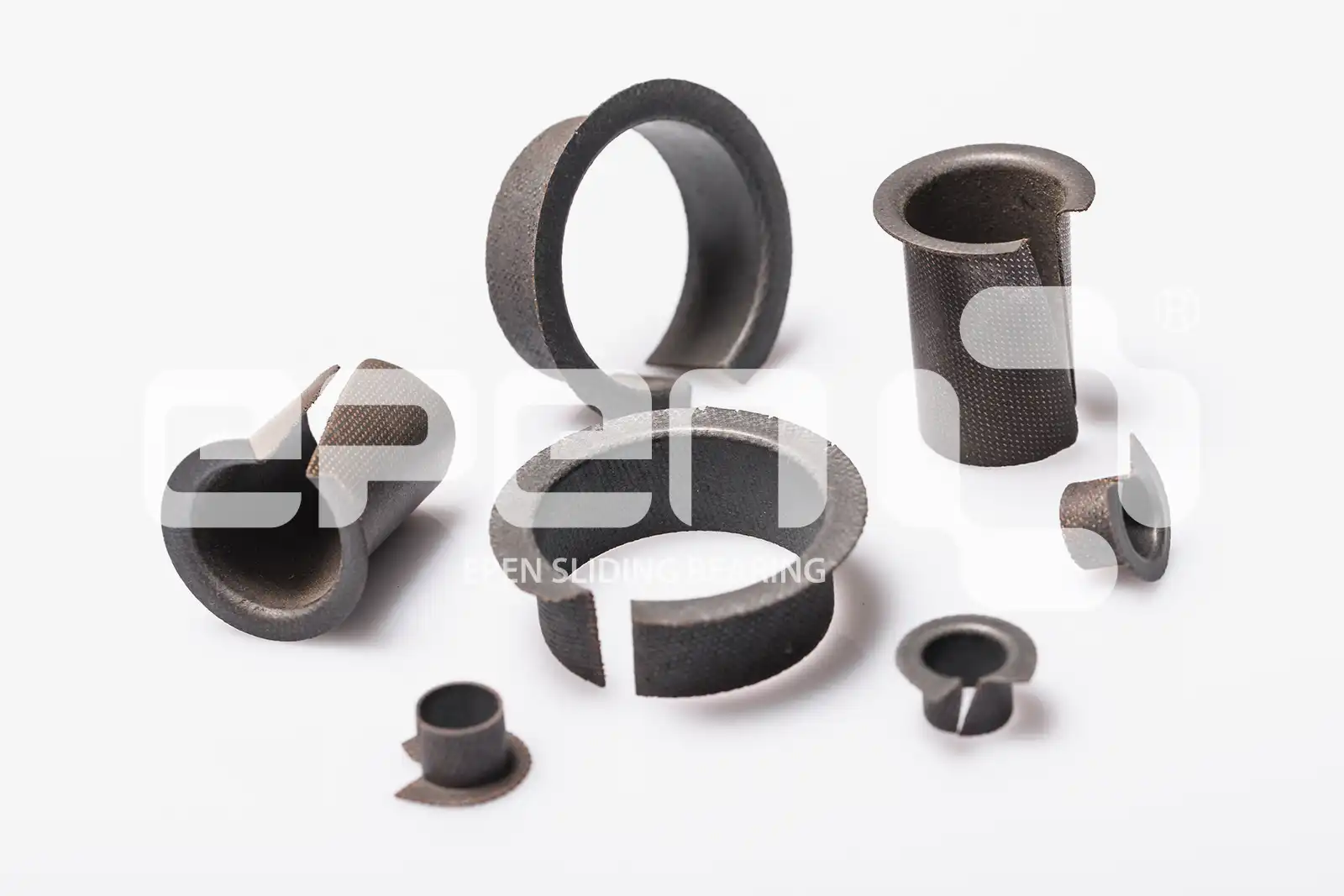
The EUR bushing is constructed in three bonded layers. A low-carbon steel backing provides structural load capacity and thermal conductivity. Onto this backing, a porous bronze layer is sintered, creating an interconnected interstitial network. Finally, a PTFE (polytetrafluoroethylene) mixture is impregnated into the bronze layer and rolled to form the sliding surface .
During operation, a portion of the PTFE mixture transfers to the mating shaft surface, forming a physically lubricating film. This film reduces friction, protects the shaft, and contributes to quiet operation .
Key Performance Characteristics
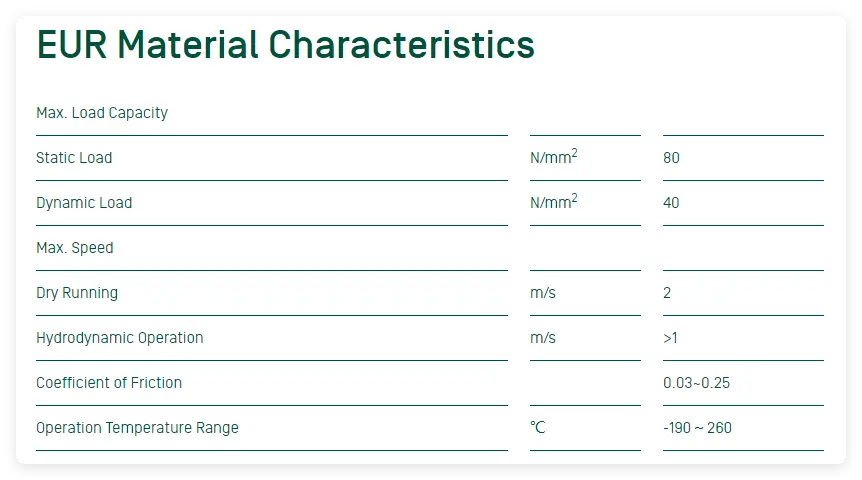
| Property | Value |
|---|---|
| Static load capacity | 250 N/mm² |
| Dynamic load capacity | 140 N/mm² |
| Coefficient of friction | 0.03–0.25 μ |
| Dry running speed | 2.0 m/s |
| Operating temperature | -195°C to +280°C |
| Thermal conductivity | 40–42 W/(m·K) |
These properties derive from the composite structure and are documented for the EUR material specification.
Design Considerations for Precision Applications
Shaft Requirements
The self-lubricating transfer film forms best on smooth, hard shaft surfaces. Hardened steel with appropriate surface finish is recommended. Shaft roughness influences both friction behavior and film formation during running-in.
Housing Fit and Clearance Control
Proper housing fit is critical for both bearing retention and vibration behavior. The housing bore typically requires an H7 fit to ensure adequate support without excessive interference that could distort the thin-wall structure . As noted in Section , clearance control is essential—keeping diametral clearance below the threshold where rattle amplitude increases significantly.
Load and Speed Limits
EUR bushings are suitable for rotary, oscillating, and axial sliding motion. The maximum dry running speed is 2.0 m/s; beyond this, hydrodynamic effects become significant and alter friction and damping characteristics.
EPEN EUR BUSHING
How EUR Precision Bushings Work to Minimize Noise & Vibration
The technical structure of EUR precision bushings stops noise from happening by using precision manufacturing and material science. These parts use a number of different engineering ideas to make bearing connections that work with significantly lower noise levels and motion frequencies than standard options.
Advanced Material Composition
The structure is made up of a hard steel backing that spreads the weight and a polished bronze layer in the middle that conducts heat and provides mechanical strength. PTFE compounds with solid lubricant additives (usually lead or molybdenum disulphide) are used on the functional surface to make a transfer film that sticks to mating shaft surfaces and renews itself. In standard metal-to-metal bearing contacts, high-frequency noise is caused by boundary friction. This three-layer design gets rid of those conditions.
Dimensional Control and Manufacturing Precision
To reduce noise, limits must be recorded in single-digit microns. EUR precision bushings have an inner diameter that stays within the H7 accuracy range. This keeps the clearance ratios stable and stops the shaft eccentricity that causes vibrations. Precision grinding operations on the sliding surface create surface finishes below 0.8 Ra, which get rid of microscopic flaws that cause vibrations. When installed correctly, these dimensional controls keep the bearing clearances between 0.01 and 0.03 mm for the life of the part, which means the kinematic performance stays stable.
Installation and Maintenance Best Practices
The efficiency of noise control is directly affected by how the installation is done. Stepped mandrels should be used for press-fitting because they spread the force evenly across the covering surface and keep it from deforming in a way that would mess up the precision hole geometry. To get a housing ready, the entry edges must be chamfered and the surface must have a finish that works with interference fit estimates. The diameter should be between 0.02 and 0.05 mm, based on the thickness of the bushing wall. Self-lubricating bushings don't need any scheduled maintenance other than a periodic inspection of the shaft. This lowers the cost of ownership while maintaining consistent performance in situations where traditional lubrication isn't possible because of access issues.
Comparing EUR Precision Bushings with Other Solutions in Noise Control
Knowing how different bearing technologies work helps procurement teams match the skills of parts to the needs of applications. Comparative analysis shows why EUR precision bushings are better at controlling noise in some operational situations.
Performance Metrics Across Bearing Types
Standard metric bushings made to general specs have 3–5 times more radial clearance than precision-grade versions. This lets the shaft bend, which causes vibrations at rotational frequencies and their harmonics. To keep boundary friction noise from happening, traditional bronze bushings need to be oiled all the time. This introduces contamination risks and maintenance needs that can't be met by sealed instrument housings. Despite having low friction, ball bearings make high-frequency noise when steel touches steel. This sound pattern is especially annoying in medical and lab equipment where noise levels must be kept to a minimum.
In static uses, EUR precision bushings can hold up to 140 MPa of force and keep their dimensions accurate to within ±0.005 mm at temperatures ranging from -40°C to +280°C. The polymer composite slide surface has friction coefficients below 0.05 without using liquid greasing. This means that there is no stick-slip phenomenon, which makes noises when used in slow motion. Durability testing shows service lives of more than 5,000 hours of steady load use. This means that parts don't need to be replaced as often and the total cost of ownership is lower.
Real-World Application Context
Companies that make automated packaging machines say that adding EUR precision bushings to guide rails and pivot points lowers the noise level by 40–60%. The self-lubricating properties stop the grease from moving, which used to contaminate products in food processing areas. CNC machine tool builders use these parts in tool changer systems to make sure that the positional reliability is within 0.002 mm for all production runs. These recorded results show real benefits that make the initial investment worth it for businesses that put quality and dependability first.
Procurement Guide: Sourcing EUR Precision Bushings for Your Business Needs
To find reliable suppliers of EUR precision bushings, you need to know about the different types of distributors, the customization options, and the quality control processes that set reliable suppliers apart from commodity vendors.
Identifying Qualified Suppliers
Reliable distributors have technical support teams that can do calculations for bearing selection based on PV values. PV values are the product of contact pressure and sliding velocity and show how much weight a bearing can hold. Quality-focused sellers give material approvals that can be linked to specific production batches. This makes it possible to figure out what went wrong if something fails in the field. Logistics skills are especially important when buying things from other countries, because the right packaging keeps precision-ground surfaces from getting damaged during shipping and customs clearance.
Well-known bearing makers like FAG, SKF, and Timken make EUR precision bushings and support them with engineering resources and global distribution networks. These companies spend money on research relationships with original equipment manufacturers (OEMs) of industrial equipment to make sure that the specs of their products meet the changing needs of automation, robots, and precision instruments.
Strategic Procurement Considerations
When compared to small-quantity sales, bulk buying usually results in 15–25% cost savings. This means that inventory planning is a powerful tool for managing costs. Customization options go beyond changing the size; they also include choosing the right material for the job and the environment. For example, high-temperature polymer formulations are available for use near heat sources, and marine environments need backing materials that don't rust. Lead times range from two weeks for standard catalogue sizes to six weeks for special specifications. This means that planning how to buy parts and when they will arrive must be done in sync with production plans.
Case Studies and Success Stories: Real-World Noise & Vibration Solutions with EUR Bushings
The real-world evidence from many different industries shows that using EUR precision bushings can actually improve performance.
Medical Device Manufacturing
Vibrations in multi-axis tracking systems made it harder for a company that makes medical robots to keep their accuracy. In rotary joints, replacing ball bearings with PTFE-lined EUR precision bushings cut positioning error from ±0.15 mm to ±0.03 mm and noise levels at the user position dropped by 12 dB. The self-lubricating features got rid of the risk of particulate pollution that came with using oil for lubrication in cleanroom assembly settings. This let the company meet ISO Class 5 cleaning standards without having to make any other changes to the enclosure.
Aerospace Component Testing
To make sure that aerospace parts were safe, vibration test fixtures needed bearings that could handle 50 g acceleration loads and keep their position during measurement cycles. Engineers asked for high-load EUR precision bushings with a backing of aluminium metal and moving layers made of strengthened PTFE. The installation got rid of noise artefacts caused by bearings in accelerometer data, which made the signal 18% clearer and cut down on test run times by making measurements more reliable. The lifespan of the components was over 8,000 test hours, which is three times better than previous bearing solutions. This meant that maintenance downtime and fixture recalibration frequency were cut down.
Industrial Robotics Assembly
A company that makes parts for cars had problems with robotic arm pivot points wearing out too quickly. This led to positional drift, which raised the rate of assembly defects. Adding solid lubricants to EUR precision bushings in the past increased the average time between repairs from 4,200 hours to over 11,000 hours and cut shaking amplitude by 35% across all working frequencies. The higher steadiness cut the number of rejected products by 2.3%, which saved money and paid for the bearing update within seven months of it being put in place. These results show that precision bushing technology can solve certain operational problems in many fields, where controlling noise and maintaining consistent dimensions have a direct effect on the quality of products and the efficiency of production.
Conclusion
To fix problems with noise and shaking in precision tools, you need engineered bearing solutions that deal with the reasons, not just the symptoms. With tight control over dimensions, advanced materials that lubricate themselves, and composite structures made just for noise reduction, EUR precision bushings make a real difference. These parts are more valuable than normal bushings and ball bearings because they can hold more weight, don't need to be maintained, and last longer. This makes them useful for activities where accuracy and dependability are important enough to spend more on better solutions. The performance claims are backed up by documented case studies from the aerospace, medical, and manufacturing industries. This gives procurement teams confidence that precision bushing technology delivers real returns through less downtime, better product quality, and lower lifecycle costs.
FAQ
1. What maintenance procedures extend precision bushing lifespan?
Self-lubricating EUR precision bushings don't need to be greased or refilled with fluid like oil-lubricated bearings do. Regularly checking the shaft to make sure the surface hardness stays above 300 HB and looking for abrasive contamination that speeds up wear is the main maintenance task. The hardness of the mating shaft sides should be at least 10 to 15 HRC different from the hardness of the bushing material. When installed correctly using press-fit tools that keep the liner from deforming, it works better at first and lasts longer.
2. Can precision bushings be customized for unique applications?
Customization choices include changing the dimensions to fit non-standard hole and shaft sizes, choosing a material that works well in harsh environments like high temperatures or corrosive atmospheres, and adding lubricant pockets for uses that need extra grease. Manufacturing wait times for custom specifications are usually between four and six weeks, but can be longer or shorter based on how complicated the order is. Minimum order numbers change from seller to supplier.
3. How do precision bushings compare cost-wise to ball bearings?
Initial component costs for EUR precision bushings are about the same as those for high-quality ball bearings. However, total lifetime costs favour bushings in situations where motion is oscillating, the environment is dirty, or mounting sites are hard to get to. Getting rid of cleaning systems, cutting down on upkeep work, and replacing parts more often all save money over the life of the equipment. This is especially true in high-reliability situations where unplanned downtime costs a lot of money.
Partner with Epen for Superior EUR Precision Bushing Solutions
Jiashan Epen Bearing Co., Ltd. makes high-performance plain bearings that are designed to keep precision instruments from making noise or vibrating. Metal-polymer composite technology and strict quality control processes are used in our EUR precision bushings product line to meet the needs of heavy machinery, industrial automation, and specialised equipment. As both a manufacturer and a supplier, we can make changes to specification details and material choices, so you can get the best solutions for your specific operational needs. Our research team can help you match the performance characteristics of a bearing to your load conditions and the surroundings. You can email us at epen@cnepen.cn to talk about your EUR precision bushing needs, get technical specs, or get quotes for standard and custom bearing solutions that make equipment more reliable while lowering its lifecycle costs.
References
1. Budynas, R.G., & Nisbett, J.K. (2020). Shigley's Mechanical Engineering Design (11th ed.). McGraw-Hill Education.
2. Harris, T.A., & Kotzalas, M.N. (2006). Essential Concepts of Bearing Technology (5th ed.). CRC Press.
3. Khonsari, M.M., & Booser, E.R. (2017). Applied Tribology: Bearing Design and Lubrication (3rd ed.). John Wiley & Sons.
4. Neale, M.J. (Ed.). (1995). The Tribology Handbook (2nd ed.). Butterworth-Heinemann.
5. Stolarski, T.A. (1990). Tribology in Machine Design. Butterworth-Heinemann.
6. ASM International Handbook Committee. (1995). Friction, Lubrication, and Wear Technology: ASM Handbook Volume 18. ASM International.

Dr. Eleanor "Ellie" Penn
Dr. Eleanor "Ellie" Penn is our Senior Tribology Specialist at Epen, where she bridges the gap between deep material science and real-world engineering challenges. With over 15 years of experience in the field of sliding bearings and self-lubricating materials, she possesses a passion for solving the most complex problems of friction, wear, and maintenance. Ellie holds a Ph.D. in Mechanical Engineering with a focus on tribology. Her mission is to empower engineers and maintenance professionals with practical knowledge and best practices that extend equipment life, reduce downtime, and drive innovation. When she's not in the lab or writing, you can find her volunteering at STEM workshops to inspire the next generation of engineers. Areas of Expertise: Sliding Bearing Design, Material Selection, Failure Analysis, Preventive Maintenance, Application Engineering.
Contact to EPEN Bearing
If you have any questions please do not hesitate to call or write us.
