The Impact of Material Selection on Bushing Service Intervals
The Impact of Material Selection on Bushing Service Intervals
Understanding Industrial Bushing Materials and Their Influence on Service Life
- Understanding Industrial Bushing Materials and Their Influence on Service Life
- Comparing Industrial Bushing Materials: Balancing Cost, Performance, and Maintenance
- Maintenance Strategies: Extending Bushing Service Intervals through Material Science
- Procurement Insights: Selecting the Right Material and Supplier for Optimized Service Intervals
- Future Outlook: Advances in Industrial Bushing Materials and Their Effect on Service Intervals
- Conclusion
- FAQ
- Partner with Epen for Optimized Industrial Bushing Solutions
- References
When I speak with mechanical engineers and procurement managers across heavy machinery and industrial sectors, one question surfaces repeatedly: why do some bushings fail prematurely while others exceed expected lifespans? The answer lies not in operational variables alone but fundamentally in material selection. Choosing the appropriate material for an industrial bushing directly determines service intervals, maintenance frequency, and ultimately, total cost of ownership. Bronze, polymer composites, steel-backed structures, and self-lubricating designs each respond differently to load, contamination, temperature, and lubrication conditions. Understanding these material behaviors transforms maintenance from reactive crisis management into predictable, cost-effective planning.
Understanding Industrial Bushing Materials and Their Influence on Service Life
The choice of material determines how well a bushing will work in a variety of situations. From the pivot points on excavators to the conveyor systems used in mining, the material chosen determines how much friction there is, how resistant it is to wear, and how long it will last in certain working situations.
Bronze Bushings: Traditional Reliability with Lubrication Demands
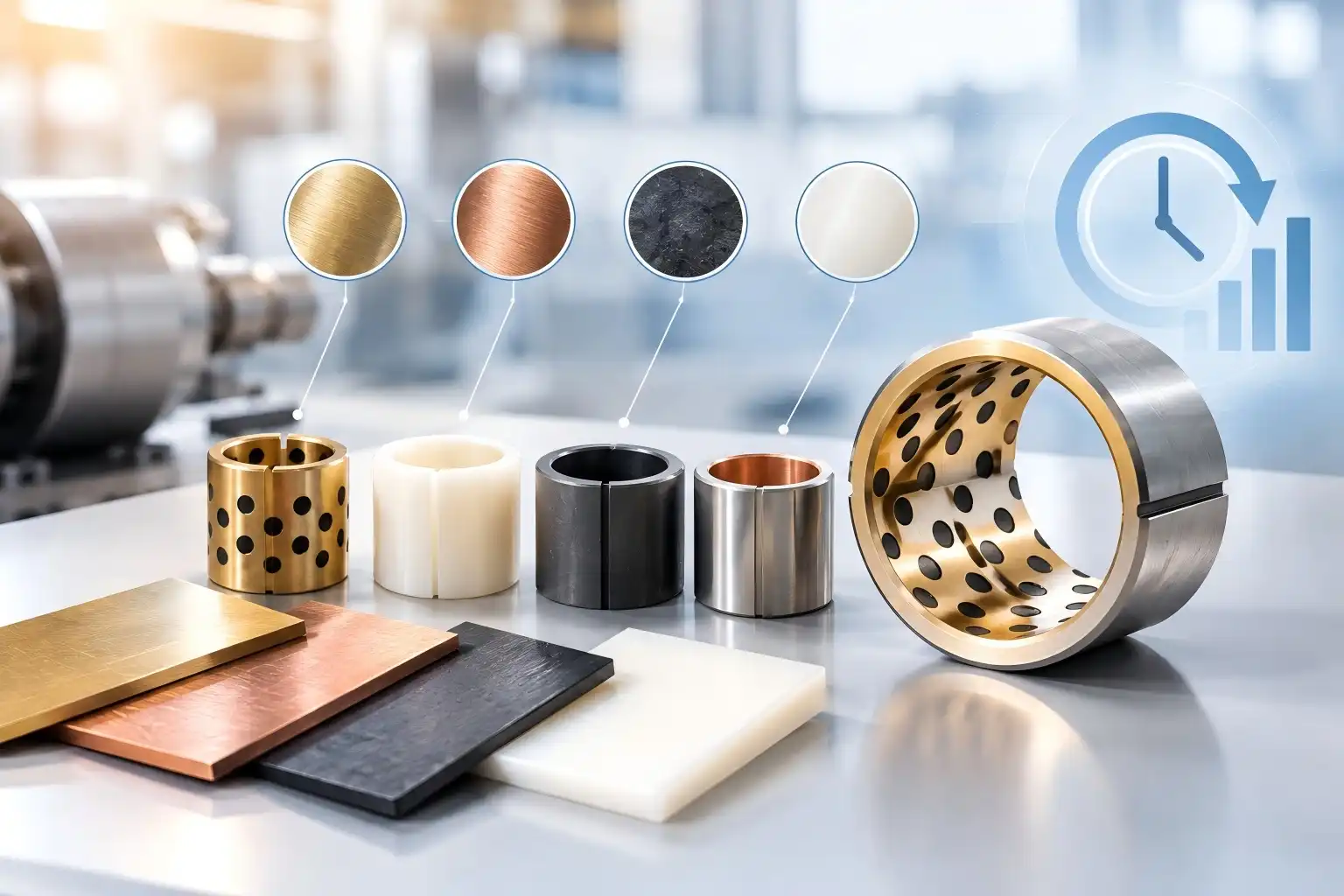
Bronze alloys, especially CuSn8 and CuPb10Sn10 mixes, have been used reliably in industry for many years. The mechanical properties of the CuPb10Sn10 bushing show the strengths of this group: it has a density of about 9.0 g/cm³, a Brinell hardness of between 70 and 100 HB, and a tensile strength of more than 280 MPa. There is 10% lead in the material, which lets it run in an emergency—if the lubrication breaks for a short time, the material lets it run without a fatal seizure. On the other hand, the 10% tin content gives it high wear strength, which is important for cranes and presses that use cyclic loads.
Bronze bushing lubrication is a complete tribological system meant to keep friction coefficients low and stop moving surfaces from wearing down on each other. Bronze bushings work in boundary, mixed-film, or hydrodynamic lubrication regimes based on speed and load, while rolling element bearings work in rolling element regimes. For solid lubrication, oil or grease must be applied on a regular basis through machined grooves in the shape of a Figure-8 or Double Loop pattern. The main problems that are dealt with are stick-slip during starting, galling under heavy contact pressure, and heat escape in high-PV (Pressure-Velocity) situations where P × V values get close to the limits of the material.
Polymer and Composite Bushings: Maintenance Reduction through Material Innovation
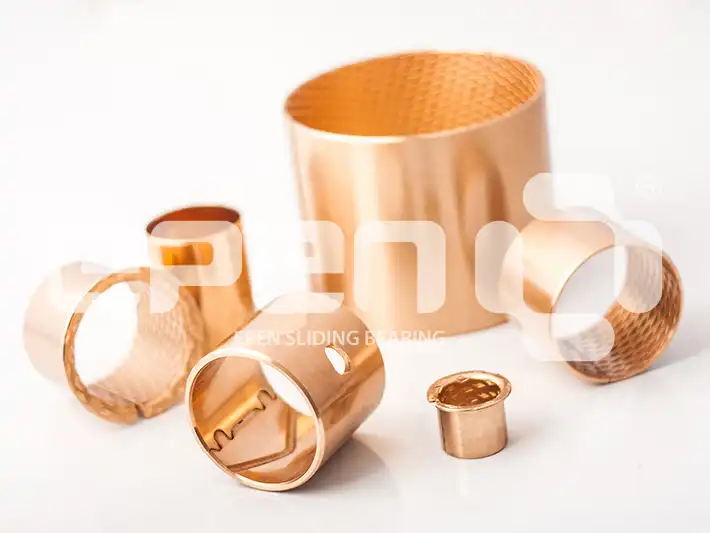
The 08dx08 industrial bushing is a great example of modern composite design. It has a steel backing with a layer of sintered bronze on top of it and a POM (acetal) lining. This three-layer design strikes a good mix between structural strength and tribological economy. DX types are different from grey PTFE-based DU bushings because their acetal lining is yellow. In contrast to fully self-lubricating designs, DX material works as a marginal lubrication bearing, meaning it needs to be greased when it is first installed, and pockets on the surface store oil for long periods of time.
Checking the mechanical stability of composite material joints is a big part of quality control. Radial crushing strength tests using the ISO 3547 method make sure that the bonded strength between the layers of resin and fibre can withstand interference fit forces without coming apart. For the best transfer film formation on mating shafts, the inside diameter surface roughness must be less than 0.4 µm. Immersion tests that check the rate of water absorption show that the volume change for wet uses stays within 0.1% of the original size. Differential Scanning Calorimetry is used for cure level analysis to check the glass transition temperature and stop creeping under long-term loads.
Material-Specific Performance in Heavy Machinery Applications
In the pivot points of a backhoe boom, a company that makes building equipment looked at bronze CuSn8 bushings and composite options. When properly greased, the bronze option worked well with dynamic loads up to 35 N/mm² and sliding speeds up to 8 m/s. Service intervals were an average of 2,800 hours of use before replacement was needed because of increased clearance caused by wear.
When the same conditions were used, the composite bushing option with solid lubricants inserted in it increased service intervals to about 4,200 hours. Because they didn't need to be oiled from the outside, upkeep work was cut by 40%, but the parts were 25–30% more expensive at first than bronze versions. When you add up the costs of downtime, labour, and replacement parts over the course of five years, the composite solution had an 18% lower total cost of ownership.
Comparing Industrial Bushing Materials: Balancing Cost, Performance, and Maintenance
When choosing a material, you have to weigh the performance of many factors against the needs of the business and your budget. Based on how they run their businesses, different industries put these factors in different order of importance.
Bronze Versus Polymer: Load Capacity and Environmental Suitability
Bronze metals can withstand high temperatures and heavy loads. CuPb10Sn10 bushings may withstand dynamic stresses of up to 40 N/mm² when used with hardened shafts (HB 200-300 advised to minimize wear). Because they are simple to produce, they may have IT7 tolerances, which is crucial for heavy equipment. Bronze doesn't rust in sulphuric acid and brine sulphite lye, making it useful in industrial and marine situations.
Polymer-based bushings have reduced friction and lower maintenance but lower load capability. Composite materials can withstand dynamic loads of 15-25 N/mm², making them suitable for industrial automation, packing, and light building appliances. The transfer coatings made by solid lubricants like graphite particles or PTFE compounds decrease friction coefficients to 0.05-0.15, compared to bronze's 0.10-0.20 when oiled. When the machine is working constantly, reducing friction uses less energy and heat.
Total Cost of Ownership: Beyond Purchase Price
Buyers are under pressure to reduce component prices, yet concentrating only on purchase price might increase long-term expenditures. This idea came from a conveyor system manufacturer researching belt tensioning assembly bushings.
Maintaining bronze industrial bushing components with fluid greasing systems required cleaning, inspecting, and re-oiling every 800 hours. Maintenance on machinery required 32 hours each year. Typical replacement cycles lasted 3,000 hours. Three years of parts, labor, and manufacturing delays cost a lot.
When self-lubricating composite bushings replaced planned lubrication, replacement intervals were 5,500 hours. Even with 35% higher beginning expenses, three-year operational costs fell 22%. Worker hours, spare parts, and production disruptions were reduced.
Distinguishing Bushings from Rolling Element Bearings
Some individuals confuse bushings with rolling element bearings when selecting materials, however they are separate tribological systems. Using lubricating films or solid transfer layers, bushings move against each other. Rollers or balls convert sliding friction to rolling friction in rolling bearings.
Bushings aid with undulating motion, large shock loads, and messy conditions. Because dust rapidly wears down rolling element bearings' fine surfaces, mining crushers and forestry machinery require bushings. Dust and shock loads are better handled by bushings than ball or roller systems because to their strength and larger contact surfaces.
Roller bearings operate best in clean, steady rotation. Better for high-speed operations, their reduced friction ratios are lost when large loads or movement changes cause the rolling parts to skid.
Maintenance Strategies: Extending Bushing Service Intervals through Material Science
Aligning upkeep procedures with the properties of the material increases the life of the component and stops it from breaking down too soon. When it comes to cleaning, tracking, and preventative care, different materials need different methods.
Material-Specific Lubrication Protocols
Lubricate bronze bushings with a consistent, working fluid. EP greases containing molybdenum disulphide or graphite operate effectively in slow-moving, heavy-load construction equipment. High-speed usage benefit from low-viscosity oils that create hydrodynamic sheets efficiently. PV controls lubrication intervals. Using a boom pivot on a backhoe with P = 25 N/mm² and V = 0.3 m/s (PV = 7.5), oiling may be necessary every 250 hours, while less loaded links may last 500-800 hours.
Once oiled, the 08dx08 bushing requires minimal maintenance. Fill acetal lining surface holes with grease after fitting. During operation, these reservoirs slowly leak oil, extending manual relubrication delays. They must be fitted properly. Stepped mandrels prevent press-fitting distortion, but direct hammering may smash the polymer liner or steel backing. The chamfered housing ends make it easy to penetrate without scraping the interior material.
Design Considerations That Enhance Material Performance
Bushings' tribological performance relies on their base material and design. Distance between bushing and shaft affects lubricant film development and wear rates. Large gaps allow lubrication to escape and misalign, increasing contact stresses. Space shortages prevent film development, worsening border contact and wear.
Surface finish specifications for the industrial bushing matter. Roughness levels of 0.8 to 1.6 µm are recommended for bronze bushings and 0.4 to 0.8 µm for mating shafts to sustain hydrodynamic films without contaminating. Composite bushing materials need finer tolerances. Lower Ra 0.4 µm liners provide a homogeneous transfer coating for low-friction operation.
Heat and cold expand and shrink the material, therefore housings must fit properly. At high temperatures, steel-backed bushings in aluminum housings differentially expand, making interference fits looser. Interference between 0.5 and 1.5% of the housing bore diameter for steel housings enables retention without stressing the hoop, which might break polymer liners.
Predictive Monitoring Aligned with Material Behavior
Measuring bronze bushing wear indicators allows condition-based maintenance. Heightened vibrations and frequency changes indicate clearances. Temperature monitoring detects improper film formation or lubrication before a seizure. Where possible, ultrasonic thickness measuring measures wall thickness.
Composite bushings seem less worn. Liner breaks, delamination, or transfer film disruption are visible during normal maintenance. Composite materials behave normally until delamination or fracture propagation leads them to fail abruptly, unlike bronze, which wears down slowly. Condition-based extension solutions are less preferred than time-based replacement strategies slightly before the estimated service life.
Procurement Insights: Selecting the Right Material and Supplier for Optimized Service Intervals
For procurement to work well, both technical evaluation of the material's suitability and evaluation of the supplier are needed to make sure that quality is always the same and the supply chain is reliable. Working with maintenance managers has taught me that relationships with suppliers are often just as important as the specs of the materials themselves.
Key Selection Criteria for Industrial Bushing Materials
Baseline material needs are set by load profile analysis. Bronze alloys are usually needed for dynamic loads above 30 N/mm², especially when they are combined with continuous rotation. When loads are mild (15 to 25 N/mm²), oscillating motion works well for composite systems. To get an accurate PV value, multiply the contact pressure by the sliding velocity. This helps you guess how long different materials will last.
Environmental factors often have a bigger impact on a material's ability to last than mechanical loads. Marine uses need materials that don't rust, so bronze alloys like CuPb10Sn10 or special polymer blends with glass fibre support are the best choices. When working in mines with rough materials, it's better to use strong metal forms that can handle particles better than fine polymer surfaces. Extreme temperatures limit the types of polymers that can be used. For example, acetal-based bushings break down after continuous use at 100°C, while PTFE composites can work up to 260°C.
Service intervals must be in line with the ability to do upkeep and the plan for output. Bronze bushings need to be inspected and oiled on a regular basis, but operations that shut down once a year can handle this. Self-lubricating designs help businesses that use continuous processes because they reduce the need for repair breaks, even if the parts may cost more.
Because of limited funds, a full assessment is needed. When you divide the total cost of ownership by the projected lifetime of the tools, you can see that premium materials often provide better value. A $150 composite bushing that lasts 5,000 hours and doesn't need any maintenance costs less per hour of use than a $95 bronze bushing that only lasts 200 hours, needs regular maintenance, and needs to be replaced at 3,000 hours.
Evaluating Suppliers: Beyond Component Specifications
Global suppliers like SKF, Timken, MISUMI, and igus offer large standard catalogues with engineering support and quality that is always the same. Their performance data, material certifications, and dimensional tolerances give buyers confidence. Established supply lines make sure that products are always available, but the higher prices show how the brand is positioned and how many services it provides.
Regional makers, like Jiashan Epen Bearing Co., Ltd., give their customers a competitive edge by letting them customise their products and communicating quickly. Epen makes metal-plastic composite bushings, bimetal bearings, and single-metal sliding bearings that are used in water conservation, building tools, and the metalworking industry. Their engineering team works together to come up with custom solutions, like changing standard designs to fit specific needs or making new materials that work well in harsh conditions. This freedom comes in handy when off-the-shelf parts don't solve certain operating problems well enough.
Custom Solutions and Bulk Ordering Advantages
Although standard catalogue bushings work well in many situations, custom designs are better for tough or unusual situations. Changing the designs of the surface pockets makes them better at keeping grease for longer periods of time. Dimensional adjustments let non-standard housing bores or shaft diameters be used without having to spend a lot of money on machining. Changes in the materials, like changing the alloys or polymers that are used, protect against certain chemicals or temperature ranges.
Ordering industrial bushing in bulk lowers the cost per unit and makes sure that there is enough inventory for planned repair programs. Suppliers can optimise production runs when they have volume commitments, which saves customers money by making the process more efficient. As part of negotiated deals, suppliers often handle inventory levels based on how much is expected to be used. This saves customers money on storage costs and guarantees that parts will be available when they need them.
Future Outlook: Advances in Industrial Bushing Materials and Their Effect on Service Intervals
New discoveries in material science keep changing what people expect from bushings in terms of performance. New technologies promise longer service intervals, less maintenance, and better sustainability, all of which are becoming more and more important to procurement professionals who are looking to the future.
Self-Lubricating Polymer Innovations
Nano-sized solid lubricants are mixed into base materials in advanced polymer formulas. These materials release particles that lubricate things more gradually and regularly than older ones, which means they can work for longer without needing to be fixed. Polyetheretherketone (PEEK) materials that are strengthened with carbon fibre and PTFE inside show amazing load capacity, almost as good as bronze performance while still being able to lubricate themselves. Operating temperatures up to 250°C continuous duty allow for more uses in places where metallic bushings were needed before.
Thermoplastic compounds that have been engineered to have holes in them soak up lubricants while they are being made, creating reservoirs inside the structure of the material. Unlike surface areas that wear away over time, these internal pathways keep lubricant flowing through the whole life of the part. Compared to traditional composite forms used in similar situations, service gaps are 40 to 60 percent longer.
Advanced Composite Structures
Multi-layer designs use a variety of different materials to improve different parts of performance. The steel backing gives the structure strength and lets heat escape. Layers of intermediately sintered brass make strong surfaces for bonding and store lubrication. Overlay polymer surfaces are smooth and don't stick to each other. New methods for quality control, like Differential Scanning Calorimetry for analysing fix levels, make sure that all production runs have the same bonding strength and size stability.
Radial crushing strength testing methods based on ISO 3547 standards can now more accurately predict service life by connecting compression data from the lab with failure modes seen in the field. This lets procurement teams set minimum levels of performance that suppliers must meet, which lowers the risk of failure before its time.
Sustainability Considerations in Material Selection
Environmental responsibility affects buying choices in more ways than just standard cost and performance calculations. Bio-based polymers, like castor oil-based polyamides and lignin-reinforced thermoplastics, are made from natural materials and are used in industrial bushing uses. In terms of load capacity and wear resistance, current performance is 15-20% worse than alternatives based on petroleum. However, this gap is constantly getting smaller as technology improves quickly.
When it comes to recycling, one-material solutions are better than mixed ones. During end-of-life processing, it takes a lot of work to separate the steel backing from the polymer liners. Bronze bushings that are made of metal can be recycled easily through established routes for scrap metal. New polymer formulations use recycled materials without changing their mechanical properties, which makes them appealing to companies that have big sustainability plans.
Longer service intervals are better for the environment because they mean fewer replacements, which means less material use, manufacturing energy, and transportation impacts over the life of the equipment. A bronze bushing needs to be replaced every 3,000 hours, but a composite bushing lasts 5,000 hours. This means that 40% less material is used over the normal life of a piece of machinery.
Conclusion
The choice of material has a big impact on how often industrial bushings need to be serviced, how much upkeep they need, and how much they cost to run. Bronze alloys have been shown to be reliable under high loads when they are oiled properly. On the other hand, advanced composites can work for a long time without any upkeep if they are used in the right way. To get the most value, procurement experts look at the total cost of ownership instead of just the prices of the parts. They do this by matching the properties of the materials to the conditions of use, the surroundings, and the ability to maintain them. New developments in self-lubricating polymers and advanced composites promise longer service intervals and better sustainability. This makes material knowledge more important for businesses that want to stay competitive.
FAQ
1. How do different materials affect bushing service intervals?
Wear rates and upkeep needs are directly affected by the qualities of the material. Bronze bushings can usually last between 2,500 and 3,500 hours of use in heavy machinery if they are oiled regularly. Self-lubricating composite designs increase intervals to 4,000 to 6,000 hours by not needing to be oiled and lowering wear caused by friction. Different environmental factors, like dust, temperature, and wetness, have different effects on materials. This is why it is important to match them correctly in order to get the rated service life.
2. What distinguishes bronze from nylon bushings in performance?
Bronze bushings can handle higher temperatures and loads (up to 40 N/mm²), but they need to be oiled every so often. Nylon and acetal composites don't need much maintenance and have less friction, but they can only handle 15 to 25 N/mm² of dynamic loads. Bronze is great for pivot points on heavy construction equipment. Composites are good for industrial automation and packaging machinery where lower maintenance costs are worth the trade-offs in load capacity.
3. Can custom bushings reduce equipment downtime?
Custom designs are made to solve specific operational problems that standard parts can't fully fix. Changing the lubrication groove patterns, making special materials that are resistant to chemicals, or making changes to the sizes of non-standard assemblies can improve performance and make them last longer between repairs. This customisation stops failures before they happen and unexpected downtime that throws off production plans.
Partner with Epen for Optimized Industrial Bushing Solutions
Selecting the right industrial bushing source has a direct effect on how well your maintenance works and how much it costs to run your business. Jiashan Epen Bearing Co., Ltd. makes a wide range of plain bushing solutions—including metal-plastic composites, bimetal bushings, and specialized wear plates—serving construction machinery, mining equipment, marine applications, and industrial automation across 30+ sectors. Our engineering team provides technical consultation to match material properties with your specific load conditions, environmental exposures, and service interval targets. Whether you need standard catalog sizes or custom-engineered solutions, we deliver competitive quality backed by responsive support. Contact our team at epen@cnepen.cn to discuss your requirements with an experienced industrial bushing manufacturer who understands the critical balance between performance, durability, and cost-effectiveness.
References
1. Neale, M.J. (2001). The Tribology Handbook, 2nd Edition. Butterworth-Heinemann, Oxford, United Kingdom.
2. Khonsari, M.M. and Booser, E.R. (2017). Applied Tribology: Bearing Design and Lubrication, 3rd Edition. John Wiley & Sons, Hoboken, New Jersey.
3. Bhushan, B. (2013). Principles and Applications of Tribology, 2nd Edition. John Wiley & Sons, Chichester, United Kingdom.
4. American Society for Testing and Materials (2019). ASTM D3702-94: Standard Test Method for Wear Rate and Coefficient of Friction of Self-Lubricating Materials. ASTM International, West Conshohocken, Pennsylvania.
5. International Organization for Standardization (2017). ISO 3547: Plain Bearings—Wrapped Bushings—Dimensions and Tolerances. ISO Central Secretariat, Geneva, Switzerland.
6. Friedrich, K. and Schlarb, A.K. (2008). Tribology of Polymeric Nanocomposites: Friction and Wear of Bulk Materials and Coatings. Elsevier Science, Amsterdam, Netherlands.

Dr. Eleanor "Ellie" Penn
Dr. Eleanor "Ellie" Penn is our Senior Tribology Specialist at Epen, where she bridges the gap between deep material science and real-world engineering challenges. With over 15 years of experience in the field of sliding bearings and self-lubricating materials, she possesses a passion for solving the most complex problems of friction, wear, and maintenance. Ellie holds a Ph.D. in Mechanical Engineering with a focus on tribology. Her mission is to empower engineers and maintenance professionals with practical knowledge and best practices that extend equipment life, reduce downtime, and drive innovation. When she's not in the lab or writing, you can find her volunteering at STEM workshops to inspire the next generation of engineers. Areas of Expertise: Sliding Bearing Design, Material Selection, Failure Analysis, Preventive Maintenance, Application Engineering.
Contact to EPEN Bearing
If you have any questions please do not hesitate to call or write us.
Recommended Blog

